07 March 2010

on display

As conservators, we are frequently involved in the preparation of objects for display in temporary or permanent exhibitions. This type of work is often challenging, for a variety of reasons, including:

  • Tight deadlines determined by a project manager or exhibition designer ... that don't take into account the practicalities of carrying out the conservation work itself.
  • A complex array of objects, in differing conditions, requiring a variety of conservation treatments.
  • Objects that tell fantastic stories, but that are in such a fragile state or deteriorated condition that it is extremely difficult to prepare them for display.
However, this type of work is also extremely fulfilling, because where the exhibitions are open to the public, we can see the outcome of our hard work, and take our families and friends along as well.

Many of the conservation treatments on objects intended for exhibitions relate to the removal of corrosion and staining as a result of ongoing deterioration so that the object can be more clearly understood when on display, as well as aiming to stabilise the condition of the object so as to halt or slow the rate of that ongoing deterioration.

As well as carrying out the actual conservation treatment, we also need to provide the curators of the exhibition with recommendations for the management of the items whilst on exhibition. These recommendations may include:

  • limits on light intensity to minimise deterioration
  • time limits for display of the object to minimise deterioration
  • need for regular cleaning or re-treatment to manage ongoing corrosion
  • methods of support or presentation that will not stress the object
Finally, we are often asked to fabricate mounts to support the objects whilst on display. This requires both an understanding of the condition of the object, and the exhibition designer's aim in displaying the object. Sometimes these requirements are in conflict, and we need to work with the exhibition designer and curator to find the optimum compromise.

Last year, International Conservation Services undertook conservation treatments on more than 150 objects destined for the new permanent exhibition at the Anzac Memorial in Hyde Park, Sydney, which was opened in November. We also prepared mounts for many of the objects.

These objects included a wide variety of wartime memorabilia and ephemera. We found this project particularly challenging because of the unexpected emotional impact of many of the objects.


In particular, working with documents such as the telegram above provided an immediate window into the emotional impact of the war on families.


The WWI miniature medal illustrated above before and after conservation had been adhered into a storage pocket. We removed it from the pocket, and carried out the following treatments:
  • cleaned with ethanol and degreased with white spirit
  • metal polished with silver cleaning cloth
  • tarnish removed with solution of thiourea in water
  • medal coated with clear lacquer to minimise tarnishing whilst on display
  • loose threads on ribbon cut, and ribbon stitched back into shape
One of the more intriguing objects we treated was this artificial leg.


A combination of rubber, wood, aluminium, copper alloy, iron alloy and canvas, it presented us with a range of challenges. Our treatments comprised:
  • brush vacuuming of the entire object
  • cleaning of iron alloy components (hinges) with white spirit, fine steel wool, and tannic acid removed with ethanol
  • cleaning of copper alloy components with a combination of dilute solutions of triammonium citrate and citric acid, and thiourea, along with mechanical methods (bamboo skewers and scalpel)
  • coating of metallic elements with microcrystalline wax to reduce the rate of ongoing corrosion whilst on display
  • reattachment of lace-up hooks

David West
International Conservation Services

18 January 2010

Christ Church in Bong Bong

One of the great things about working in conservation is that almost all of our work makes a difference, both to the objects that we conserve, and for the people to whom the objects are significant.

But from time to time, we get the opportunity to work on projects where the difference our work makes is highly visible, even transformative.

Such was the case late last year with our work on the decorated interiors of the Anglican Christ Church at Bong Bong in the Southern Highlands of NSW. Listed on the NSW State Heritage Register, it is the oldest church in the region, dating from 1845, and for some time, it was the only church between Sydney and Goulburn.

International Conservation Services was originally requested to conserve the interior paintings and decorative elements of the church. But after some discussions with the parish, we found that we could help the church with a broader project involving advice on the colour scheme, redesign of the internal church lighting, as well as work on the timber pews and running a training course for the parish members on how to care for them.

The large areas of flaking paint found in the artwork and decorative paintwork of the ceiling were of primary concern to our painting conservation team of Adam Godijn, Arek Werstak and Matteo Volonte, who spent a long fortnight working in demanding conditions of up to 40 deg C just below the ceiling of the church.

The flaking paint areas were consolidated as a priority before the extensive cleaning works required to the decorative ceiling were commenced. In order to avoid the heat, the team worked as early in the morning as possible.

After cleaning and consolidation of the paint layers, the losses were filled and inpainted before a final varnish layer was applied. This reversible varnish layer serves as a protective coating from the dust, dirt and debris that will collect in time, and also improves the appearance of the decoration by saturating the surface.

During planning for these works, we undertook a variety of paint investigations around the church to confirm the extent of original decorative finishes, and to attempt to identify the original colour scheme. These investigations uncovered many interesting things.

We discovered that the white gloss enamel painted window frames originally had a wood grained finish. A specialist decorator was brought in to re-create this original wood-grained effect. Apart from looking much more interesting the dark oak-like wood grain significantly enhances and highlights the beautiful stained glass windows.

Investigations around the gothic lettering at the front of the church found that the original lettering was much more ornate, and much more in keeping with the style of the surrounding decorations. The existing lettering was quite harsh in blue and red, whereas the original lettering had three colours - red, blue and gold leaf. After some discussions, the original lettering was replicated.


The plain sections of the church interior were repainted by a local tradesman using a colour scheme developed from original colours revealed by our paint scrapes, and in consultation with representatives of the churchwardens.

During the painting works, all of the plaques on the walls had to be removed, so the opportunity was taken to clean and polish them all before they were re-installed after the painting works were complete.

And finally a new lighting system was installed that provides both uplight onto the ceiling decoration and also spotlights the decorative verses on the two end walls.

You can read more about our work in this article in the Southern Highland News.

We are delighted to have been able to contribute to revealing this real gem of a church interior in a historic region of NSW. Services are held in the church each Sunday if you are interested in visiting.

David West and Adam Godijn

25 August 2009

art in hospitals

Over the past 15 months, we've been providing art management services to a group of hospitals to help them improve the experience of their patients. There is substantial literature describing the benefits of having art in hospitals, particularly with regard to facilitating a positive state of mind and accelerating the healing process.

Initially, our role was to audit and catalogue their art collection, and to improve the rotation and hanging of these works across the group of hospitals. We also developed a labelling protocol to provide more opportunities for patients, staff and visitors to interact with the artworks.

Lately, we've been working with artists in the communities around these hospitals to arrange temporary exhibitions of artworks. These exhibitions provide an ever-changing array of artworks to improve the experience of longer-term patients and staff, and also provide an alternative venue for artists to display their works (and hopefully sell some of them).

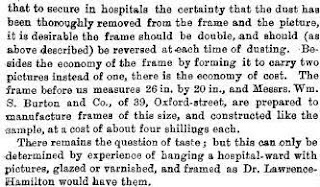
However, this post was actually triggered by the discovery of an article in the 20 October 1877 edition of the very important medical journal "The Lancet" entitled 'Art in Hospitals'. This article outlined the development (by a doctor) of a frame for artwork specifically designed to address the hygiene and safety issues particular to hospitals.

from "The Lancet", 20 October 1877
Interestingly (and not surprisingly), this concern for hygiene and safety remains valid for our work today. Whilst much of the artwork is hung in public spaces such as foyers and corridors, there are situations such as operating theatres and intensive care units where we need to take into consideration very particular requirements for the framing and cleaning of any artwork.
David West

16 August 2009

memories of the trams

We frequently find ourselves working on unusual items. Recently, our textiles conservator was asked to treat this tram roll by a private collector. It had developed black mould staining and orange-brown iron staining whilst in storage.

Because the tram roll was fabric, and the ink used to colour it was water-soluble (and thus we could not use water-based solutions for cleaning), the treatment was quite difficult. Whilst we were able to remove a substantial amount of general soiling, and reduce the visibility of both the mould and the iron stains, in this instance it was not possible to totally remove the stains.

It was interesting timing for us, because one of our other clients, the Historic Houses Trust of NSW is currently staging an exhibition called Shooting Through: Sydney by Tram at the Museum of Sydney. Associated with this exhibition are a variety of events, including an interesting seminar on 25 September, "Nostalgia vs Reality: are trams the answer?", exploring the potential for trams to solve Sydney's transport woes.

David West

09 August 2009

a new memorial

Although the focus of our business is conservation, we believe that we also have a contribution to make during the design and creation of new artworks, memorials and other structures. As conservators, we have a very good understanding of the way in which materials deteriorate over time. With this insight, we are able to provide artists and designers with advice on how their scheme might behave after it has been made or constructed, and installed. When there are sufficient resources for us to contribute in this way, we are able to guide the artist or designer with their selection of materials and detailing of the memorial or artwork so as to minimise the risk of undesired deterioration, and to extend the likely service life of the item in use.

Which means of course that we won't be called in after just a few years to advise on how to fix up the problems which might otherwise occur! But we'd much rather not be trying to conserve items that are only a few years old, because it is always a very difficult exercise. Not only do we have to convince the owner to spend more money on the item, but we have to work with the artist or designer to develop alternative detailing solutions that often, from their point of view, compromise the item which looked so good when it was completed.

The most recent example of us providing this type of advice is the recently opened Australian Korean War Memorial at the northern end of Moore Park.

We worked with the artist, Jane Cavanough, and the landscape designers, POD, throughout the detailed design process to optimise the long-term durability of the memorial through careful material choices and design detailing. Recently opened, the memorial is an inspiring place despite its location between two major arterial roads into the city.

David West
International Conservation Services

24 July 2009

dancing in the gardens

Yesterday we were pleased to be present in the Royal Botanic Gardens, Sydney, when the marble statue "La Ballarina" was unveiled after conservation works by us. Here is the transcript of Julian Bickersteth's speech about our work on the statue at the unveiling:

The role of statuary as an essential part of great gardens is a universal one. I was recently at Sissinghurst, the Kent Castle where Vita Sackville West and Harold Nicholson created one of the great gardens of England between the wars. Harold was the garden planner, and on purchasing the property with its derelict gardens he hot footed it to Italy to buy classical statuary to provide focus for his garden vistas and spaces.

Fifty years previously Charles Moore, the Director of these Royal Botanic Gardens had been driven by the same desire to see statuary as an integral part of the design of the Gardens. "La Ballarina" as she stands somewhat coyly before us, is a direct result of his vision. Moore was lucky in that he was living in a time when contemporary values supported this vision. Prince Albert, Queen Victoria’s consort, was keen on the so-called ‘uplifting of the lower orders’, and promoted the use of classical statuary in gardens to educate those who could not afford the ‘grand tour’. Much closer to home Sir Henry Parkes was an enthusiastic provider of public sculpture to beautify the colony, and was responsible for sourcing and importing various sculptures from Italy for the 1879 Garden Palace International Exhibition.

"La Ballarina" (please note the 'a' in the middle where we would expect an 'e') dates from 1883 when it was part of a group of eight marble statues imported from Italy. These include the four allegorical statues of the "Seasons", and the "Boy extracting a thorn", a still much loved statue on the hill behind us. As was reported at the time:

An additional attraction has been given to our Botanic Gardens, in the form of eight marble statues which now gleam white against masses of dark green foliage in various angles of the many walks which are so much appreciated by our citizens and visitors”.

So what do we know of "La Ballarina"? She is a copy of a famous statue by Antonio Canova, the Venetian sculptor who lived from 1757 to 1822, whose work included "The Three Graces" now in the Hermitage, and "Theseus and the Minotaur" in the Victoria & Albert Museum. The original of "La Ballarina" has since disappeared but it is listed in Canova’s work as "La Danzatrice con il dito al mento (the Dancer with the finger on chin)". Finished in 1814 she was sold to a Russian diplomat.

The copy you see before us was almost certainly (I shall come back to the almost later) sculpted by an Australian, Charles Summers, who although born in Melbourne in 1858, had moved to Rome with his parents aged 11. He ran a successful business reproducing famous sculptures including those of Canova, was said to be friendly with two popes and made regular trips to Australia to sell his wares.
Unfortunately, however, over the years these sculptures fell upon hard times. Physically they were damaged by anything from a falling branch to a reversing truck. And perhaps more disastrously they fell victim to changing attitudes, ranging from the ‘menace to public morals’ of the more flagrant nudes in the early twentieth century, to the mass replication of classical statuary in suburban gardens in the 1970s, making them appear somewhat naff. How "La Ballarina" came to be headless and footless we do not know but at some stage in the 1960s or '70s she was moved to what is known by the RBG staff as ‘the Graveyard’, behind the Succulent Garden.

We now live in more enlightened times and it is wonderful to see these vital elements of the Gardens being restored. So my company was delighted when we were approached to undertake the restoration of "La Ballarina" as part of the Royal Botanic Gardens' heritage statuary program. The process has been an interesting one, as it is not quite as simple as plonking a block of marble on La B's head and carving something appropriate.

First of all we needed to ensure we knew what we were carving, bearing in mind La B’s title ("the Dancer with the finger on chin") in that we had no chin nor a finger to touch it with, nor incidentally a right foot. So we went to the Canova Foundation in Canova’s home town of Passagno near Venice, where they hold a gypsum copy of the statue, to see if they could either organise the copy of a head for us to be carved, or provide good quality photos that we could copy here. Quick as a flash came back a letter from one Carlo Nicoli, declaring that he could see from our photos that the statue had been made in an ‘exceptional way’ by his great grandfather, another Carlo Nicoli, and that he would be happy to reproduce the head if we could ship the whole statue to him. Happily however we were able to source from the Canova Foundation high quality photos of the copy, and more happily source here in Lidcombe the carving skills of Polish-born master mason Jacek Luszcyk. So what you see before you is Jacek’s wonderful work, copying from photos the form and feel of the original.

But the story was not quite over yet, as finding a piece of pure white Carrara marble of suitable size and carving quality is not as easy as popping down to your local Bunnings. We could find nothing in Australia and so went back to the Carrara area eventually sourcing from the appropriately named Cave Michelangelo a block of stone of the right quality and size. I say appropriately named because it was from the Seravezza quarry in Carrara where Michelangelo sourced the blocks of marble of such astonishing size and purity from which David and the Pieta and indeed all his sculptures were carved. Of such value was this marble that Michelangelo laconically noted the deaths of two marble workers in the quarry during lowering down a piece of marble whilst bewailing the shattering of a piece of marble that represented months of labour and many thousands of dollars in its retrieval.

The process of replicating a carved work is a complicated one. Firstly the photographs were gridded up and divided into a series of points to allow for accurate measurement. Then clay mock ups of the missing head and limbs were crafted on the statue. These were extensively reviewed and altered until all parties were happy that they reflected the original. The clay forms were then removed and plaster casts made of them. The new marble was cut to size and the process of carving began, working from the plaster casts. Before these were finished they were doweled and glued to the original statue, and the finer details around the join completed. The result was once again reviewed and small alterations made, and now you see the result before you.

Thus has been the story of the restoration of "La Ballarina". Her vital missing elements have been restored, her original parts cleaned, and she has been returned to her proper form and place here in the Gardens. Her head, fingers and feet once again gleam white against the dark foliage, and though this currently appears somewhat as odds with her original elements, rest assured in no more than a few months she will have weathered to once again look her full harmonious and seductive self.

Thank you.

You can read more about the unveiling in the Sydney Morning Herald, watch the ABC News report, or look at more photos from the unveiling.

David West
International Conservation Services

18 July 2009

our lunar heritage

One of my earliest memories is being sat down in front of our black and white television set to watch the first moon landing. I couldn't have told you the date, but given that Monday 20 July will be the 40th anniversary, I know that I was 4 years old at the time. Of course, many of us have stories about this moment that changed our history.

Over the years, ICS has conserved some fascinating artefacts and industrial objects, but today I'm writing about a project that some of our fellow conservators at Conservation Solutions in the US worked on for several years.


At the Johnson Space Center in Houston, Texas, the only remaining space-ready Saturn V rocket has been on display for over thirty years. Designed as a single-use object, that merely had to survive the very high loads during the launch acceleration, and ravaged by the extremely harsh climate in Houston (high temperatures, high humidity, high ozone and high salinity, not to mention the occasional hurricane), this rocket was in a very poor state in 2002 when the conservation works commenced.

I was fortunate enough to visit the site in November 2004 when Conservation Solutions had completed much of their investigation, analysis, trials and planning works ... and were about to commence the task of conserving the 100m long rocket. You can read more about the project here and here.

For me, one of the most fascinating aspects of this conservation project was the research work that the Conservation Solutions team had to undertake in order to discover just what materials had been used. Despite the rocket having only been built during the 1960s, less than 40 years previously, and despite being part of the enormous space program run by the USA at the time, records of the construction of the Saturn V rocket were incredibly difficult to obtain. Indeed, I understand that much of the information about the construction was gleaned from amateur rocket enthusiasts who had collected memorabilia and magazine articles from the 1960s, and who could tell, admittedly anecdotal, stories about the challenges of building and launching the rockets.

Having identified the materials of construction, another enormously challenging task for Conservation Solutions was to develop appropriate conservation techniques for modern materials that were no longer made, yet for which little, if any, previous conservation work had ever been undertaken.

And of course, for conservators, the challenge of scale was almost overwhelming. Used to working with scalpels and dentist drills, the tools of choice for conserving the Saturn V rocket included ultra-high pressure water jets.


The challenges of conserving the artefacts of our industrial and technological heritage are enormous - not only are there questions of authenticity around materials and finishes, but there are also the challenges of function and operability ... and there are always conflicts between these that have to be resolved. Planning can take into consideration many eventualities, but inevitably we face surprises once the conservation works begin.

David West
International Conservation Services

07 July 2009

uncovering ned kelly

In our last post, we talked about Ned Kelly, and a depiction of his trial in a large tapestry. Today, we're still talking about Ned Kelly - but this time it is about a forthcoming television documentary on the archaeological excavation of the Ann Jones' Inn, site of the 1880 siege by the Ned Kelly gang in Glenrowan, Victoria.
In May 2008, ICS Senior Objects Conservator Karina Acton provided specialist conservation advice to the Dig International team during this excavation. This site is best known as the site of the Ned Kelly siege in 1880.
The excavation discovered a fascinating variety of artefacts and remains of the Ann Jones Inn, and you can find out more this Thursday 9 July at 8.30pm on ABC television when "Ned Kelly Uncovered", hosted by Tony Robinson of "Time Team" fame, goes to air.

19 May 2009

Nolan, Kelly and a tapestry

"The tiled floor in red and white was in a house I was in once. The courthouse was in South Melbourne and through the left-hand window you can see sailing ships of the time. The candelabra is true to life. The judge wears the black cloth of death and below is a sergeant with a rolled, sealed document that seals doom for Kelly. Of course, it could not have been ready. Kelly told Judge Barry that he would soon see him in the next world, which is not a very polite thing to say to a man who's just sentenced you to death. Strangely enough, Mr Justice Barry, a great man, who did many good deeds, went home to bed and died a fortnight later, from, it is said, a septic carbuncle."
Reproduced from Sidney Nolan's Ned Kelly Paintings in the National Gallery of Australia with essays by Murray Bail and Andrew Sayers

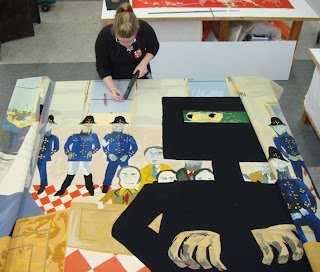
Over the past few weeks our Textiles Conservator has been carrying out conservation and maintenance work on a large tapestry from the Federal Law Courts in Sydney. The tapestry is a reproduction of Sidney Nolan's 1947 painting entitled "The Trial", which is held in the collection of the National Gallery of Australia.

The tapestry was produced under the supervision of Sidney Nolan in Portugal by Manufactura de Tapecarias de Portalegre, probably during the 1980s, and was in good condition when we received it from the Federal Law Courts. However, it had become quite soiled after hanging in the lobby outside Law Court 21A for many years.

Our challenge with cleaning large tapestries is to remove as much dirt as possible without damaging the tapestry - and when we're talking about something that measures more than 4m x 3m, and weighs 15-20kg dry (and three to four times that wet), this challenge can be substantial.
It is made even more difficult by the tendency of some dyes to run when exposed to water for a length of time. So the first challenge with any tapestry is to test the solubility and stability of every different colour of yarn used. In this case, we found that the red yarn began to run after 30 minutes of exposure to water ... and as you can see in the image of the original painting above, there is a lot of red, and it adjoins a lot of white or cream!

So in this case, we could not wash the tapestry with water, or use any stain removal reagents in aqueous solutions. Instead, our approach was to use a combination of brush vacuuming, tweezers (it's like picking needles from a haystack), and localised solvent cleaning. This approach is resulting in a substantial improvement in the condition of the tapestry.

Whilst not all of this improvement is visible to the naked eye, the removal of the particulate matter has a double benefit - not only does it slow down the deterioration of the tapestry by removing the generally acidic dust, it also reduces the rate of ongoing accumulation of dust (yes, dust begets dust - generally due to the static charges on the particulate matter).

Museum of Australian Democracy at OPH

The Museum of Australian Democracy at Old Parliament House was opened last week.

Our contribution to MOAD was relatively small - particularly compared to the amount of work we've undertaken at Old Parliament House over the past few years - but important nonetheless. During the design of the new exhibitions in 2008, we provided detailed recommendations on how to install the exhibitions into the building with minimal impact on the significant heritage fabric of the building.

We were fortunate enough to be part of the soft opening for museum and heritage professionals last night. Primed by an inspiring speech on the nature and value of democracy by artist Robyn Archer, we were most interested to see how the galleries that housed the National Portrait Gallery (now of course housed in their own purpose-built building almost over the road) had been redesigned.

Context is everything they say, and there can no more appropriate building in which to talk about democracy, or indeed space within a building, as the Museum opens directly off King’s Hall, with the House of Reps on the left and the Senate on the right. The themes it covers are those to be expected; Bill of Rights, the Constitution, suffragettes etc. but the nature of the space, which is the old Parliamentary Library, suits silos of information delivered in this way.

It’s a didactic exhibition, i.e. heavy on words without a large number of objects, but there is a lot of information to get across. The main gallery is dominated by the ’timeline’, a vast lectern type installation with a series of touch screens, which allows you to data mine deep into a whole range of issues and events according to the period you have selected.

I never find openings the easiest time to assess exhibitions, but this has the look and feel of a well researched and well presented exhibition. It is not as big as I thought, but it has the relocated and revamped Prime Ministers of Australia Gallery next to it, a new visitor experience now happening in the cabinet room (Cabinet in confidence), and a temporary exhibition called Living Democracy: the Power of the People soon to open.

Overall, I am a great fan of Old Parliament House as a building, and it is great to see its reason for existence post Parliamentary use finally having real resonance and meaning.

Julian Bickersteth
International Conservation Services