Showing posts with label textiles conservation. Show all posts

16 June 2010

a window into our domestic past

Whilst a proportion of our work involves objects of high artistic value, we also work on many objects with substantial historic significance. Sometimes this historic significance resides with the object itself. At other times, the significance arises because the object is part of a larger collection.

The textiles we have been treating from Calthorpes’ House in Canberra, a historic house museum under the care of ACT Historic Places, are an example of the latter. My particular interest in this project was triggered by our work on the leather pouffe from this collection, which reminded me of the pouffe that was a favourite item of furniture in my early childhood. But more about that later. The story about this collection of textiles from Calthorpes’ House is much more interesting than that.


Calthorpes’ House, in Mugga Way, Red Hill, is significant as an example of one of the many styles of architecture in Canberra during the city’s fledgling years. It is one of the few houses from that time with all of its original features remaining, including its gardens and sheds. But the most significant aspect of Calthorpes’ House is that the furniture and other contents of the house are virtually unchanged, much of it dating back to the original occupation of the house in July 1927. The ACT Historic Places website says “Calthorpes’ House is a window into an almost forgotten world … this genuine survivor is a treasure house of domestic history.

Owned and occupied by Harry and Dell Calthorpe from 1927 until Mrs Calthorpe’s death in 1979, the house remains a significant feature in the historic fabric of Canberra, providing an example of how one family grew and changed with the times over a period of 50 years. Mrs Calthorpe was particularly careful with her possessions, and whilst changes were made, many of the objects were kept and repaired and continued to be used.

Recently, we undertook a condition assessment of all of the textiles in the collection at Calthorpes’ House, comprising over 500 objects in total. We were then commissioned to undertake conservation treatments on a number of the historic soft furnishings, including curtains, lampshades, a bedspread, bolster cushion and a pouffe, all of which appear to be original to the House.

Detail of pouffe surface, showing the faded colours

One of the much-loved features of the Calthorpes’ House Breakfast Room is a leather and early plastic pouffe (stuffed footstool or ottoman). The exact date of purchase of this pouffe is unknown. When it was new, it would have been a mix of vibrant red, maroon and bright green leather, however the colours have faded over time, and they are now a mix of maroon, red and tan. In addition to fading surface colours, the zipper had been damaged, and several seams had spilt. It was definitely in need of some attention from a conservator!

Detail of split seam on pouffe prior to treatment

Treatment on the pouffe began, with the split seams and broken zipper being repaired. Unfortunately, light damage cannot be reversed, meaning that nothing could be done about the fading colours on the surface of the footstool.

As the treatment progressed, a surprise emerged: the stuffing of the footstool comprised a variety of different clothing and textile items from the House! We knew they originally came from the House because they had tags with “Calthorpes” sewn onto them. Items found to be inside the footstool included carpet off-cuts, pyjamas, skirts, baby’s clothes, doll’s clothes, socks and even an outdoor summer tent! The clothes contained inside the pouffe reflect the styles of a bygone era, possibly discarded by the family as they had been outgrown or did not conform with the fashions of the day.

And this is where my childhood memories come in, because I recall that the pouffe in our home was also stuffed with oddments of fabric and clothing. These made it heavy, and awkward to handle, but also meant that when you sat on it or rested your feet on it, you could settle into position and then it would not move.

The question is – were the discarded Calthorpes’ clothes in their pouffe the original stuffing of an object acquired at a later date? Or were they a later stuffing of the pouffe after the original stuffing was no longer functional?

Objects found inside the pouffe (a) outdoor summer tent (b) pyjama top

All of the items removed from inside the pouffe were cleaned and re-housed in textile boxes, and a custom-made Dacron insert fitted in place of the clothing insert. The Dacron insert makes the footstool lighter and easier to maneuver, and will also allow it to keep its shape better.

In addition to the pouffe, a number of lace and velvet curtains were also treated. These curtains originated from the Sitting Room, Dining Room, Breakfast Room and Bedroom 1. All of the velvet curtains and pelmets in the House are original, however many of the lace curtains are reproductions, with the originals having been stored to reduce further damage.

It is interesting to note that all of the lace curtains on the windows are reproductions, while the lace curtains on internal doors are original. This demonstrates the effect light can have on sensitive items, as the window curtains, although reproductions, were in worse condition than the original curtains still hanging on internal doors, which are protected from extended exposure to light. The window curtains had yellowed considerably, and had numerous tears and pulls. There was also a faint smoke/nicotine odour. The internal door curtains had similar damage, although they were not as badly damaged as those on the windows.

Lace curtain during treatment

Each of the lace curtains removed for treatment was washed, lined and couched before being returned to their original locations.

The velvet curtains and pelmets underwent a similar treatment to that of the lace curtains, although they were only surface cleaned, not washed, due to their fragile nature. A number of the curtains underwent stain reduction treatments, and many of the corners were repaired where they had frayed. The braids and tassels were also stabilised and repaired where possible.

Decorative tassel during treatment

ACT Historic Places has a conservation policy for Calthorpes’ House which is based on conserving objects in their current state, rather than restoring them to original (or close to original) condition. As a result, alterations to the building fabric and its contents are kept to a minimum, and are undertaken in order to keep the House and its contents in a stable condition, and as close to their state when the House was acquired in 1984 as possible. To that end, our treatments on the pouffe and curtains were minimal, and were aimed at stabilising the damage, rather than restoring the objects to their original condition.

David West and Erin Watson
International Conservation Services

07 March 2010

on display

As conservators, we are frequently involved in the preparation of objects for display in temporary or permanent exhibitions. This type of work is often challenging, for a variety of reasons, including:

  • Tight deadlines determined by a project manager or exhibition designer ... that don't take into account the practicalities of carrying out the conservation work itself.
  • A complex array of objects, in differing conditions, requiring a variety of conservation treatments.
  • Objects that tell fantastic stories, but that are in such a fragile state or deteriorated condition that it is extremely difficult to prepare them for display.
However, this type of work is also extremely fulfilling, because where the exhibitions are open to the public, we can see the outcome of our hard work, and take our families and friends along as well.

Many of the conservation treatments on objects intended for exhibitions relate to the removal of corrosion and staining as a result of ongoing deterioration so that the object can be more clearly understood when on display, as well as aiming to stabilise the condition of the object so as to halt or slow the rate of that ongoing deterioration.

As well as carrying out the actual conservation treatment, we also need to provide the curators of the exhibition with recommendations for the management of the items whilst on exhibition. These recommendations may include:

  • limits on light intensity to minimise deterioration
  • time limits for display of the object to minimise deterioration
  • need for regular cleaning or re-treatment to manage ongoing corrosion
  • methods of support or presentation that will not stress the object
Finally, we are often asked to fabricate mounts to support the objects whilst on display. This requires both an understanding of the condition of the object, and the exhibition designer's aim in displaying the object. Sometimes these requirements are in conflict, and we need to work with the exhibition designer and curator to find the optimum compromise.

Last year, International Conservation Services undertook conservation treatments on more than 150 objects destined for the new permanent exhibition at the Anzac Memorial in Hyde Park, Sydney, which was opened in November. We also prepared mounts for many of the objects.

These objects included a wide variety of wartime memorabilia and ephemera. We found this project particularly challenging because of the unexpected emotional impact of many of the objects.


In particular, working with documents such as the telegram above provided an immediate window into the emotional impact of the war on families.


The WWI miniature medal illustrated above before and after conservation had been adhered into a storage pocket. We removed it from the pocket, and carried out the following treatments:
  • cleaned with ethanol and degreased with white spirit
  • metal polished with silver cleaning cloth
  • tarnish removed with solution of thiourea in water
  • medal coated with clear lacquer to minimise tarnishing whilst on display
  • loose threads on ribbon cut, and ribbon stitched back into shape
One of the more intriguing objects we treated was this artificial leg.


A combination of rubber, wood, aluminium, copper alloy, iron alloy and canvas, it presented us with a range of challenges. Our treatments comprised:
  • brush vacuuming of the entire object
  • cleaning of iron alloy components (hinges) with white spirit, fine steel wool, and tannic acid removed with ethanol
  • cleaning of copper alloy components with a combination of dilute solutions of triammonium citrate and citric acid, and thiourea, along with mechanical methods (bamboo skewers and scalpel)
  • coating of metallic elements with microcrystalline wax to reduce the rate of ongoing corrosion whilst on display
  • reattachment of lace-up hooks

David West
International Conservation Services

16 August 2009

memories of the trams

We frequently find ourselves working on unusual items. Recently, our textiles conservator was asked to treat this tram roll by a private collector. It had developed black mould staining and orange-brown iron staining whilst in storage.

Because the tram roll was fabric, and the ink used to colour it was water-soluble (and thus we could not use water-based solutions for cleaning), the treatment was quite difficult. Whilst we were able to remove a substantial amount of general soiling, and reduce the visibility of both the mould and the iron stains, in this instance it was not possible to totally remove the stains.

It was interesting timing for us, because one of our other clients, the Historic Houses Trust of NSW is currently staging an exhibition called Shooting Through: Sydney by Tram at the Museum of Sydney. Associated with this exhibition are a variety of events, including an interesting seminar on 25 September, "Nostalgia vs Reality: are trams the answer?", exploring the potential for trams to solve Sydney's transport woes.

David West

19 May 2009

Nolan, Kelly and a tapestry

"The tiled floor in red and white was in a house I was in once. The courthouse was in South Melbourne and through the left-hand window you can see sailing ships of the time. The candelabra is true to life. The judge wears the black cloth of death and below is a sergeant with a rolled, sealed document that seals doom for Kelly. Of course, it could not have been ready. Kelly told Judge Barry that he would soon see him in the next world, which is not a very polite thing to say to a man who's just sentenced you to death. Strangely enough, Mr Justice Barry, a great man, who did many good deeds, went home to bed and died a fortnight later, from, it is said, a septic carbuncle."
Reproduced from Sidney Nolan's Ned Kelly Paintings in the National Gallery of Australia with essays by Murray Bail and Andrew Sayers

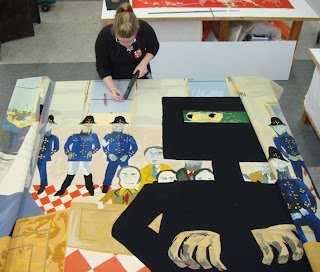
Over the past few weeks our Textiles Conservator has been carrying out conservation and maintenance work on a large tapestry from the Federal Law Courts in Sydney. The tapestry is a reproduction of Sidney Nolan's 1947 painting entitled "The Trial", which is held in the collection of the National Gallery of Australia.

The tapestry was produced under the supervision of Sidney Nolan in Portugal by Manufactura de Tapecarias de Portalegre, probably during the 1980s, and was in good condition when we received it from the Federal Law Courts. However, it had become quite soiled after hanging in the lobby outside Law Court 21A for many years.

Our challenge with cleaning large tapestries is to remove as much dirt as possible without damaging the tapestry - and when we're talking about something that measures more than 4m x 3m, and weighs 15-20kg dry (and three to four times that wet), this challenge can be substantial.
It is made even more difficult by the tendency of some dyes to run when exposed to water for a length of time. So the first challenge with any tapestry is to test the solubility and stability of every different colour of yarn used. In this case, we found that the red yarn began to run after 30 minutes of exposure to water ... and as you can see in the image of the original painting above, there is a lot of red, and it adjoins a lot of white or cream!

So in this case, we could not wash the tapestry with water, or use any stain removal reagents in aqueous solutions. Instead, our approach was to use a combination of brush vacuuming, tweezers (it's like picking needles from a haystack), and localised solvent cleaning. This approach is resulting in a substantial improvement in the condition of the tapestry.

Whilst not all of this improvement is visible to the naked eye, the removal of the particulate matter has a double benefit - not only does it slow down the deterioration of the tapestry by removing the generally acidic dust, it also reduces the rate of ongoing accumulation of dust (yes, dust begets dust - generally due to the static charges on the particulate matter).