 "The tiled floor in red and white was in a house I was in once. The courthouse was in South Melbourne and through the left-hand window you can see sailing ships of the time. The candelabra is true to life. The judge wears the black cloth of death and below is a sergeant with a rolled, sealed document that seals doom for Kelly. Of course, it could not have been ready. Kelly told Judge Barry that he would soon see him in the next world, which is not a very polite thing to say to a man who's just sentenced you to death. Strangely enough, Mr Justice Barry, a great man, who did many good deeds, went home to bed and died a fortnight later, from, it is said, a septic carbuncle."Reproduced from Sidney Nolan's Ned Kelly Paintings in the National Gallery of Australia with essays by Murray Bail and Andrew Sayers
Over the past few weeks our Textiles Conservator has been carrying out conservation and maintenance work on a large tapestry from the Federal Law Courts in Sydney. The tapestry is a reproduction of Sidney Nolan's 1947 painting entitled "
The Trial", which is held in the collection of the
National Gallery of Australia.
The tapestry was produced under the supervision of Sidney Nolan in Portugal by
Manufactura de Tapecarias de Portalegre, probably during the 1980s, and was in good condition when we received it from the Federal Law Courts. However, it had become quite soiled after hanging in the lobby outside Law Court 21A for many years.
Our challenge with cleaning large tapestries is to remove as much dirt as possible without damaging the tapestry - and when we're talking about something that measures more than 4m x 3m, and weighs 15-20kg dry (and three to four times that wet), this challenge can be substantial.
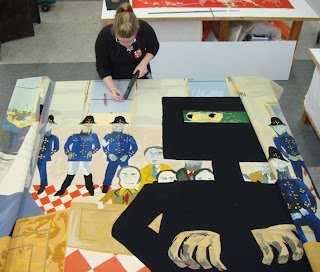
It is made even more difficult by the tendency of some dyes to run when exposed to water for a length of time. So the first challenge with any tapestry is to test the solubility and stability of every different colour of yarn used. In this case, we found that the red yarn began to run after 30 minutes of exposure to water ... and as you can see in the image of the original painting above, there is a lot of red, and it adjoins a lot of white or cream!
So in this case, we could not wash the tapestry with water, or use any stain removal reagents in aqueous solutions. Instead, our approach was to use a combination of brush vacuuming, tweezers (it's like picking

needles from a haystack), and localised solvent cleaning. This approach is resulting in a substantial improvement in the condition of the tapestry.
Whilst not all of this improvement is visible to the naked eye, the removal of the particulate matter has a double benefit - not only does it slow down the deterioration of the tapestry by removing the generally acidic dust, it also reduces the rate of ongoing accumulation of dust (yes, dust begets dust - generally due to the static charges on the particulate matter).

 In May 2008, ICS Senior Objects Conservator Karina Acton provided specialist conservation advice to the Dig International team during this excavation. This site is best known as the site of the Ned Kelly siege in 1880.
 The excavation discovered a fascinating variety of artefacts and remains of the Ann Jones Inn, and you can find out more this Thursday 9 July at 8.30pm on ABC television when "Ned Kelly Uncovered", hosted by Tony Robinson of "Time Team" fame, goes to air.


