16 June 2010

a window into our domestic past

Whilst a proportion of our work involves objects of high artistic value, we also work on many objects with substantial historic significance. Sometimes this historic significance resides with the object itself. At other times, the significance arises because the object is part of a larger collection.

The textiles we have been treating from Calthorpes’ House in Canberra, a historic house museum under the care of ACT Historic Places, are an example of the latter. My particular interest in this project was triggered by our work on the leather pouffe from this collection, which reminded me of the pouffe that was a favourite item of furniture in my early childhood. But more about that later. The story about this collection of textiles from Calthorpes’ House is much more interesting than that.


Calthorpes’ House, in Mugga Way, Red Hill, is significant as an example of one of the many styles of architecture in Canberra during the city’s fledgling years. It is one of the few houses from that time with all of its original features remaining, including its gardens and sheds. But the most significant aspect of Calthorpes’ House is that the furniture and other contents of the house are virtually unchanged, much of it dating back to the original occupation of the house in July 1927. The ACT Historic Places website says “Calthorpes’ House is a window into an almost forgotten world … this genuine survivor is a treasure house of domestic history.”

Owned and occupied by Harry and Dell Calthorpe from 1927 until Mrs Calthorpe’s death in 1979, the house remains a significant feature in the historic fabric of Canberra, providing an example of how one family grew and changed with the times over a period of 50 years. Mrs Calthorpe was particularly careful with her possessions, and whilst changes were made, many of the objects were kept and repaired and continued to be used.

Recently, we undertook a condition assessment of all of the textiles in the collection at Calthorpes’ House, comprising over 500 objects in total. We were then commissioned to undertake conservation treatments on a number of the historic soft furnishings, including curtains, lampshades, a bedspread, bolster cushion and a pouffe, all of which appear to be original to the House.

Detail of pouffe surface, showing the faded colours

One of the much-loved features of the Calthorpes’ House Breakfast Room is a leather and early plastic pouffe (stuffed footstool or ottoman). The exact date of purchase of this pouffe is unknown. When it was new, it would have been a mix of vibrant red, maroon and bright green leather, however the colours have faded over time, and they are now a mix of maroon, red and tan. In addition to fading surface colours, the zipper had been damaged, and several seams had spilt. It was definitely in need of some attention from a conservator!

Detail of split seam on pouffe prior to treatment

Treatment on the pouffe began, with the split seams and broken zipper being repaired. Unfortunately, light damage cannot be reversed, meaning that nothing could be done about the fading colours on the surface of the footstool.

As the treatment progressed, a surprise emerged: the stuffing of the footstool comprised a variety of different clothing and textile items from the House! We knew they originally came from the House because they had tags with “Calthorpes” sewn onto them. Items found to be inside the footstool included carpet off-cuts, pyjamas, skirts, baby’s clothes, doll’s clothes, socks and even an outdoor summer tent! The clothes contained inside the pouffe reflect the styles of a bygone era, possibly discarded by the family as they had been outgrown or did not conform with the fashions of the day.

And this is where my childhood memories come in, because I recall that the pouffe in our home was also stuffed with oddments of fabric and clothing. These made it heavy, and awkward to handle, but also meant that when you sat on it or rested your feet on it, you could settle into position and then it would not move.

The question is – were the discarded Calthorpes’ clothes in their pouffe the original stuffing of an object acquired at a later date? Or were they a later stuffing of the pouffe after the original stuffing was no longer functional?

Objects found inside the pouffe (a) outdoor summer tent (b) pyjama top

All of the items removed from inside the pouffe were cleaned and re-housed in textile boxes, and a custom-made Dacron insert fitted in place of the clothing insert. The Dacron insert makes the footstool lighter and easier to maneuver, and will also allow it to keep its shape better.

In addition to the pouffe, a number of lace and velvet curtains were also treated. These curtains originated from the Sitting Room, Dining Room, Breakfast Room and Bedroom 1. All of the velvet curtains and pelmets in the House are original, however many of the lace curtains are reproductions, with the originals having been stored to reduce further damage.

It is interesting to note that all of the lace curtains on the windows are reproductions, while the lace curtains on internal doors are original. This demonstrates the effect light can have on sensitive items, as the window curtains, although reproductions, were in worse condition than the original curtains still hanging on internal doors, which are protected from extended exposure to light. The window curtains had yellowed considerably, and had numerous tears and pulls. There was also a faint smoke/nicotine odour. The internal door curtains had similar damage, although they were not as badly damaged as those on the windows.

Lace curtain during treatment

Each of the lace curtains removed for treatment was washed, lined and couched before being returned to their original locations.

The velvet curtains and pelmets underwent a similar treatment to that of the lace curtains, although they were only surface cleaned, not washed, due to their fragile nature. A number of the curtains underwent stain reduction treatments, and many of the corners were repaired where they had frayed. The braids and tassels were also stabilised and repaired where possible.

Decorative tassel during treatment

ACT Historic Places has a conservation policy for Calthorpes’ House which is based on conserving objects in their current state, rather than restoring them to original (or close to original) condition. As a result, alterations to the building fabric and its contents are kept to a minimum, and are undertaken in order to keep the House and its contents in a stable condition, and as close to their state when the House was acquired in 1984 as possible. To that end, our treatments on the pouffe and curtains were minimal, and were aimed at stabilising the damage, rather than restoring the objects to their original condition.

David West and Erin Watson
International Conservation Services

05 May 2010

the value of recognition

Over the past couple of weeks, I have been reflecting on the value of recognition; and in particular, the recognition that arises from awards.  In the heritage conservation sector in NSW, the annual Energy Australia National Trust Heritage Awards are the most prominent; a range of professional organisations include a heritage award within their annual awards (e.g. the Australian Institute of Architects' annual Lachlan Macquarie Award); and an increasing number of local governments hold annual heritage awards.

All of these awards programs have several things in common:
  • They promote best practice in heritage conservation
  • They recognise and acknowledge the work involved in achieving good heritage conservation outcomes
  • They publicise the efforts of owners of heritage items or places, and of the participants in the heritage conservation process
And of course, because awards have to be presented, they usually provide an opportunity for members of the sector to gather together and share experiences.

The catalyst for my reflection on the value of heritage awards was the recognition given to several projects that International Conservation Services has contributed to over the past couple of years at the 2010 Energy Australia National Trust Heritage Awards presented at the Westin Hotel in Sydney on 12 April 2010.

Christ Church, Bong Bong
Award, Conservation of Built Heritage

Dunbar Anchor
Award, Maritime Heritage

Royal Botanic Gardens Heritage Statuary Conservation
Commendation, Conservation of Built Heritage

Sydney Harbour YHA, The Rocks
Commendation, Development

But the real purpose of this blog post was to reflect on how we can all do better at sharing the knowledge, the skills, the experience, and the conservation outcomes, that derive from these award-winning projects.

First and foremost, we need to promote the awards.  We need to tell stories about the awards, and about the award-winning projects.  We need the winners of the awards to post the information on their websites, send newsletters and emails about the awards, and not be shy about promoting the news that they received an award.  Why?  Because publicity about the awards builds interest and builds recognition that the award winning projects represent a benchmark, a level of practice that is desirable and that is achievable.

Secondly, we need to share stories about the work that was done on the projects that were awarded.  We need to publish the reports (online preferably); create photo galleries (online again); give presentations and tours; tell stories about the challenges, the successes, and the failures (yes, the failures) that occurred in the course of completing these award-winning projects.  Sharing these experiences will help us all develop our skills, and disseminate the knowledge that will help more of us do better work more of the time.

Finally, we need to encourage our peers, our partners, our clients, our consultants and our contractors to nominate their projects for awards.  At International Conservation Services, we have been nominating projects for the National Trust Heritage Awards for more than a decade.  Along the way, we've had a number of projects which were recognised with commendation, and this year, 2010, two of our projects received awards.  We're proud of all of these projects.  Just as we're proud of all our other projects that were nominated and not recognised, or the vast array of projects that we didn't nominate for a wide variety of reasons.  Our challenge to ourselves is to share more information about our projects with our community.  Which in a way brings me full circle to the reason why we write this blog!

David West
International Conservation Services

21 April 2010

building over archaeological remains

Two weeks ago, I was delighted to attend the official opening of the Sydney Harbour YHA and the Big Dig Archaeology Education Centre by the Patron of YHA Australia, Her Excellency the Governor General of the Commonwealth of Australia Ms Quentin Bryce AC.

View of The Big Dig Archaeology Education Centre from the Sydney Harbour YHA, looking over some of the archaeological remains exposed on the site.

Located between Cumberland Street and Gloucester Street in The Rocks, Sydney, this development over one of Australia's largest urban archaeological sites is the result of over fifteen years of work by the Sydney Harbour Foreshore Authority, land managers for the site, and over six years of work by YHA.

Archaeological excavation of this site was commenced in 1994 by Godden Mackay (now Godden Mackay Logan), and we first provided conservation advice on the archaeological remains at that time.

The remains excavated on the site revealed over thirty dwellings along two streets and two laneways, dating from 1795 to the late 19th Century.  Somewhere between 750,000 and 1.2 million artefacts were excavated (the number depends on who you talk to!).  The research associated with the archaeological excavation led to a wonderful book about the site by Grace Karskens, entitled "Inside the Rocks: the Archaeology of a Neighbourhood".

But enough background.  The real highlight of the official opening was the opportunity to see this new building designed by Tzannes Associates in operation.  Built over the archaeological remains, we provided input during the concept design stage to minimise the impact of the building on the exposed remains.  We also developed options for the protection of the remains during construction, and in conjunction with Built, the builders, we monitored the protection system throughout construction.  We also documented all necessary conservation works to the archaeological remains.

Cumberland Street entry to the Sydney Harbour YHA:
the interpretive screens echo the original terrace houses on the site.

Whilst one of the key marketing pitches for the Sydney Harbour YHA has been the wonderful view of the Sydney Opera House and Circular Quay from the rooftop terrace, light rain in the morning meant that the official opening was relocated into the Anne Armsden Room on Level 1.  This meant that we walked through the reception area, and the main common room, at around 10.30am on a wet morning.  Guests were checking out, using the internet, reading books, having coffee - and the coffee tables are wonderful glass cases containing selections of artefacts from the site!  There was a fantastic energy about the building.

During her official opening speech, Her Excellency shared with us her experiences immediately prior to the official ceremony - she too was captivated by the opportunities for children to learn about history and archaeology at the Big Dig, as well as by the experience for international visitors to live over such a key part of Australia's early history.

After the official opening, we wandered off to inspect some guest rooms, to admire the view from the rooftop terrace, and then most importantly, to head downstairs to walk along the public laneways and view the in situ archaeological remains.  Of course, we paused to look at the variety of interpretive panels located on walls and handrails around the building.

We also popped into the Big Dig Archaeology Education Centre which is located on the site.  Two classrooms, and a dedicated space for some hands-on simulated archaeological excavation activities for children.  We watched delightedly as a group of children listened intently to a costumed coal lumper from the wharves talk about the house he lived in, and introduce a couple of his (also costumed) neighbours to the group.  When we left the site half an hour later, the kids were still clustered around these characters, actively engaging with their stories of the past.

Sydney Harbour YHA is a wonderful new development that provides an innovative way of experiencing part of the history of The Rocks - you can stay in the heart of Sydney at very reasonable rates - consider it for your next visit to Sydney or weekend away!

David West
International Conservation Services

24 March 2010

conserving heritage furniture

Conserving heritage furniture often challenges us to resolve conflicts between authenticity, minimal intervention and reversibility, and the need or desire for the furniture to continue to be used.

Recently we were presented with a set of such challenges as we embarked on a six-month long project to conserve the heritage Council Chamber furniture from the Sydney Town Hall.

This suite of Australian red cedar furniture was originally made by William Coleman for the Council Chamber of the Sydney Town Hall in 1883. The furniture was built to a design by one of the architects for the Town Hall, John Hennessey.

Photo: Historic image of the furniture in the Council Chamber of the Sydney Town Hall.

Comprising a long D-end table in two separate sections, the Lord Mayoral chair, 17 tub chairs, and 4 long benches (2 curved, 2 straight), all pieces of the suite were showing the signs of having been very well-used over a long period of continual service to the Council.

The tub chairs and benches had been re-upholstered numerous times, most recently in a manner quite different to the original. The legs of the chairs had been substantially modified, with repairs, replacements and extensions, none of which matched the original intent or appearance of the chairs. The tables had suffered mainly due to age and use, as well as through the cutting of holes and slots for telephone and computer cables.

The brief from our client, the City of Sydney, was to return the suite of furniture close to its intended original appearance whilst ensuring that it retained the patina of age and history. In addition, as the furniture was proposed to continue to be used for public events and functions, it was important that the conserved items be functional.

Photos: Tub chair prior to (L) and after (R) conservation

As a result of the original design and fabrication of the furniture, we needed to stabilise all of the joints in the tub chairs, and drew on a range of techniques to do this including:

  • Injection of animal hide glue
  • Dismantling of joints (by unscrewing, as the chairs had no traditional mortice and tenon joints), cleaning and re-gluing
  • Re-securing the screws
  • Installation of large curved blocks to the inside of the seat using adhesive
Previous unsympathetic (and weak) extensions to the legs of the tub chairs were removed. We designed and fabricated new extensions which were milled from old Australian cedar to match the original timber, and which followed the original form based on historic photographs.

We completed an assortment of other treatments in order to rectify damage caused by previous repairs or modifications to the tub chairs.

A decision was made at the beginning of the project to retain one of the seventeen tub chairs in the condition we received it in order to show the range of past repairs.

We decided to replace all of the leather during our conservation works, as none of the extant upholstery was original, nor did it look like the original. The tub chairs and benches were re-upholstered to match as closely as possible the original upholstery based on our interpretation of remnant physical evidence and the historic image above. Most notable is the recreation of the original buttoning.

Upon completion of the physical conservation works, the timber elements were refinished with shellac and waxed.

Photo: Council Chamber furniture after conservation works complete

Perhaps the greatest challenge with this project was resolving issues arising from the well-meaning repair and modification works carried out to the Council Chamber furniture in the course of its 125 year history.  It is likely that few of these repair and modification works would have been carried out with any anticipation that one day this suite of furniture would have such historic significance to the City of Sydney.  We are pleased that we have been able to unravel some of the changes that had occurred over time, to reveal the original form of this imposing furniture.

David West
International Conservation Services

16 March 2010

reversing the damage of a previous restoration

Photo: Overall shot before treatment

A beautifully painted portrait of a lady arrived at our door in a horrendous condition. The canvas had suffered severe shrinkage, the paint layer had been forced together, and having nowhere to go, had lifted away from the canvas forming tent-like shapes across the surface of the painting.

Photo: Close up of paint layer

As we investigated the cause of the canvas shrinkage, we found that a restorer had previously attempted to line the canvas using a water based adhesive. Lining is a procedure where a new canvas is adhered to the original canvas in order to add strength and support. However, we try to avoid lining paintings unless it is absolutely necessary because of the risks involved. Poorly executed lining can cause shrinkage of the canvas with associated damage to the paint layer, but can also change the texture and gloss of the paint layer. When carried out correctly, lining can result in a successful stabilisation of the painting without harm.

As conservators we think a lot about how we are going to treat an object. Often, it seems to us that conservation can be more about knowing what we cannot do rather than what we can. It is very easy to re-touch that missing section of paint, or glue a sculpture back together, but what are the consequences of our actions? In essence, this is what our training and code of ethics are all about – how do we treat the problems with an artwork or artefact whilst maintaining its significance and authenticity, and causing no harm to it now or in the future.

Our treatment of this painting was a lengthy and slow process. Over weeks the adhesive was slowly removed, first by softening it with solvents, and then by mechanically scraping away the adhesive. Simultaneously, we slowly stretched the canvas on an expandable stretcher, millimetre by millimetre. Once the canvas was its original size the tenting paint was then laid back into place.

The varnish layer on top of the paint was also badly damaged from the cracking and needed to be removed. Unfortunately, as the varnish was not a conservation grade varnish, it was not soluble in any solvents that did not also damage the paint layer. Consequently, the varnish had to be mechanically scraped away, which took one conservator three weeks to do.

Photo: After treatment

Finally, we lined the painting using the correct materials and processes, before varnishing, filling of losses and re-touching of damage. The overall results were very pleasing but some evidence of the damage still remains in the surface texture.

Photo: After treatment detail

Projects like this remind us of the challenges our clients face in finding a conservator. Conservators undergo extensive training, and generally specialise in just one field, e.g. paintings or paper or sculpture or metals or furniture / wood or textiles. Most conservators have tertiary qualifications – either an undergraduate or masters degree – and have several years experience on the job working with another experienced conservator in one area of conservation alone. When you find a conservator, it is always worth asking them about their qualifications, area of specialisation and experience, and if they have carried out this sort of treatment before.

Communication is also important so that both you and the conservator understand what you wish to achieve from the conservation treatment, and what the conservator expects the outcome from treatment is likely to be. Returning a painting or artefact to a “new” condition is rarely possible or appropriate, but treating it to bring it into a stable and presentable condition is almost always achievable. Prevention of damage is always far better than a cure, and once you have found a good conservator you can be confident that they have the best interests of your artwork, antique or artefact in mind.

Adam Godijn
International Conservation Services


07 March 2010

on display

As conservators, we are frequently involved in the preparation of objects for display in temporary or permanent exhibitions. This type of work is often challenging, for a variety of reasons, including:

  • Tight deadlines determined by a project manager or exhibition designer ... that don't take into account the practicalities of carrying out the conservation work itself.
  • A complex array of objects, in differing conditions, requiring a variety of conservation treatments.
  • Objects that tell fantastic stories, but that are in such a fragile state or deteriorated condition that it is extremely difficult to prepare them for display.
However, this type of work is also extremely fulfilling, because where the exhibitions are open to the public, we can see the outcome of our hard work, and take our families and friends along as well.

Many of the conservation treatments on objects intended for exhibitions relate to the removal of corrosion and staining as a result of ongoing deterioration so that the object can be more clearly understood when on display, as well as aiming to stabilise the condition of the object so as to halt or slow the rate of that ongoing deterioration.

As well as carrying out the actual conservation treatment, we also need to provide the curators of the exhibition with recommendations for the management of the items whilst on exhibition. These recommendations may include:

  • limits on light intensity to minimise deterioration
  • time limits for display of the object to minimise deterioration
  • need for regular cleaning or re-treatment to manage ongoing corrosion
  • methods of support or presentation that will not stress the object
Finally, we are often asked to fabricate mounts to support the objects whilst on display. This requires both an understanding of the condition of the object, and the exhibition designer's aim in displaying the object. Sometimes these requirements are in conflict, and we need to work with the exhibition designer and curator to find the optimum compromise.

Last year, International Conservation Services undertook conservation treatments on more than 150 objects destined for the new permanent exhibition at the Anzac Memorial in Hyde Park, Sydney, which was opened in November. We also prepared mounts for many of the objects.

These objects included a wide variety of wartime memorabilia and ephemera. We found this project particularly challenging because of the unexpected emotional impact of many of the objects.


In particular, working with documents such as the telegram above provided an immediate window into the emotional impact of the war on families.


The WWI miniature medal illustrated above before and after conservation had been adhered into a storage pocket. We removed it from the pocket, and carried out the following treatments:
  • cleaned with ethanol and degreased with white spirit
  • metal polished with silver cleaning cloth
  • tarnish removed with solution of thiourea in water
  • medal coated with clear lacquer to minimise tarnishing whilst on display
  • loose threads on ribbon cut, and ribbon stitched back into shape
One of the more intriguing objects we treated was this artificial leg.


A combination of rubber, wood, aluminium, copper alloy, iron alloy and canvas, it presented us with a range of challenges. Our treatments comprised:
  • brush vacuuming of the entire object
  • cleaning of iron alloy components (hinges) with white spirit, fine steel wool, and tannic acid removed with ethanol
  • cleaning of copper alloy components with a combination of dilute solutions of triammonium citrate and citric acid, and thiourea, along with mechanical methods (bamboo skewers and scalpel)
  • coating of metallic elements with microcrystalline wax to reduce the rate of ongoing corrosion whilst on display
  • reattachment of lace-up hooks

David West
International Conservation Services

18 January 2010

Christ Church in Bong Bong

One of the great things about working in conservation is that almost all of our work makes a difference, both to the objects that we conserve, and for the people to whom the objects are significant.

But from time to time, we get the opportunity to work on projects where the difference our work makes is highly visible, even transformative.

Such was the case late last year with our work on the decorated interiors of the Anglican Christ Church at Bong Bong in the Southern Highlands of NSW. Listed on the NSW State Heritage Register, it is the oldest church in the region, dating from 1845, and for some time, it was the only church between Sydney and Goulburn.

International Conservation Services was originally requested to conserve the interior paintings and decorative elements of the church. But after some discussions with the parish, we found that we could help the church with a broader project involving advice on the colour scheme, redesign of the internal church lighting, as well as work on the timber pews and running a training course for the parish members on how to care for them.

The large areas of flaking paint found in the artwork and decorative paintwork of the ceiling were of primary concern to our painting conservation team of Adam Godijn, Arek Werstak and Matteo Volonte, who spent a long fortnight working in demanding conditions of up to 40 deg C just below the ceiling of the church.

The flaking paint areas were consolidated as a priority before the extensive cleaning works required to the decorative ceiling were commenced. In order to avoid the heat, the team worked as early in the morning as possible.

After cleaning and consolidation of the paint layers, the losses were filled and inpainted before a final varnish layer was applied. This reversible varnish layer serves as a protective coating from the dust, dirt and debris that will collect in time, and also improves the appearance of the decoration by saturating the surface.

During planning for these works, we undertook a variety of paint investigations around the church to confirm the extent of original decorative finishes, and to attempt to identify the original colour scheme. These investigations uncovered many interesting things.

We discovered that the white gloss enamel painted window frames originally had a wood grained finish. A specialist decorator was brought in to re-create this original wood-grained effect. Apart from looking much more interesting the dark oak-like wood grain significantly enhances and highlights the beautiful stained glass windows.

Investigations around the gothic lettering at the front of the church found that the original lettering was much more ornate, and much more in keeping with the style of the surrounding decorations. The existing lettering was quite harsh in blue and red, whereas the original lettering had three colours - red, blue and gold leaf. After some discussions, the original lettering was replicated.


The plain sections of the church interior were repainted by a local tradesman using a colour scheme developed from original colours revealed by our paint scrapes, and in consultation with representatives of the churchwardens.

During the painting works, all of the plaques on the walls had to be removed, so the opportunity was taken to clean and polish them all before they were re-installed after the painting works were complete.

And finally a new lighting system was installed that provides both uplight onto the ceiling decoration and also spotlights the decorative verses on the two end walls.

You can read more about our work in this article in the Southern Highland News.

We are delighted to have been able to contribute to revealing this real gem of a church interior in a historic region of NSW. Services are held in the church each Sunday if you are interested in visiting.

David West and Adam Godijn

25 August 2009

art in hospitals

Over the past 15 months, we've been providing art management services to a group of hospitals to help them improve the experience of their patients. There is substantial literature describing the benefits of having art in hospitals, particularly with regard to facilitating a positive state of mind and accelerating the healing process.

Initially, our role was to audit and catalogue their art collection, and to improve the rotation and hanging of these works across the group of hospitals. We also developed a labelling protocol to provide more opportunities for patients, staff and visitors to interact with the artworks.

Lately, we've been working with artists in the communities around these hospitals to arrange temporary exhibitions of artworks. These exhibitions provide an ever-changing array of artworks to improve the experience of longer-term patients and staff, and also provide an alternative venue for artists to display their works (and hopefully sell some of them).

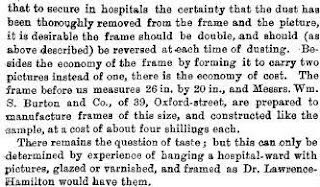
However, this post was actually triggered by the discovery of an article in the 20 October 1877 edition of the very important medical journal "The Lancet" entitled 'Art in Hospitals'. This article outlined the development (by a doctor) of a frame for artwork specifically designed to address the hygiene and safety issues particular to hospitals.

from "The Lancet", 20 October 1877
Interestingly (and not surprisingly), this concern for hygiene and safety remains valid for our work today. Whilst much of the artwork is hung in public spaces such as foyers and corridors, there are situations such as operating theatres and intensive care units where we need to take into consideration very particular requirements for the framing and cleaning of any artwork.
David West

16 August 2009

memories of the trams

We frequently find ourselves working on unusual items. Recently, our textiles conservator was asked to treat this tram roll by a private collector. It had developed black mould staining and orange-brown iron staining whilst in storage.

Because the tram roll was fabric, and the ink used to colour it was water-soluble (and thus we could not use water-based solutions for cleaning), the treatment was quite difficult. Whilst we were able to remove a substantial amount of general soiling, and reduce the visibility of both the mould and the iron stains, in this instance it was not possible to totally remove the stains.

It was interesting timing for us, because one of our other clients, the Historic Houses Trust of NSW is currently staging an exhibition called Shooting Through: Sydney by Tram at the Museum of Sydney. Associated with this exhibition are a variety of events, including an interesting seminar on 25 September, "Nostalgia vs Reality: are trams the answer?", exploring the potential for trams to solve Sydney's transport woes.

David West

09 August 2009

a new memorial

Although the focus of our business is conservation, we believe that we also have a contribution to make during the design and creation of new artworks, memorials and other structures. As conservators, we have a very good understanding of the way in which materials deteriorate over time. With this insight, we are able to provide artists and designers with advice on how their scheme might behave after it has been made or constructed, and installed. When there are sufficient resources for us to contribute in this way, we are able to guide the artist or designer with their selection of materials and detailing of the memorial or artwork so as to minimise the risk of undesired deterioration, and to extend the likely service life of the item in use.

Which means of course that we won't be called in after just a few years to advise on how to fix up the problems which might otherwise occur! But we'd much rather not be trying to conserve items that are only a few years old, because it is always a very difficult exercise. Not only do we have to convince the owner to spend more money on the item, but we have to work with the artist or designer to develop alternative detailing solutions that often, from their point of view, compromise the item which looked so good when it was completed.

The most recent example of us providing this type of advice is the recently opened Australian Korean War Memorial at the northern end of Moore Park.

We worked with the artist, Jane Cavanough, and the landscape designers, POD, throughout the detailed design process to optimise the long-term durability of the memorial through careful material choices and design detailing. Recently opened, the memorial is an inspiring place despite its location between two major arterial roads into the city.

David West
International Conservation Services