Showing posts with label conservators. Show all posts

20 October 2010

raising a toast to heritage

For regular readers of this blog, you'll know that our conservators work hard, often on painstakingly repetitive tasks.  And so at the end of the week, there is often cause to celebrate in the timeworn Australian tradition.  With a cold beer or a glass of wine.

But for the past couple of years, we have actually been working with one of Australia's iconic beverage businesses to help them manage their heritage collections.  This blog is about our work with Foster's Group.  

When you hear the name Foster's, you almost certainly think of “beer” or “wine” – you probably don’t think “heritage collection”.  However, Foster’s has an impressive heritage collection, built up over the years by its various brands, some of which trace their history back nearly 200 years.

Foster’s is proud of its heritage and its heritage collection, and is keen to see the collection survive well into the future. With this in mind, we have been working with Foster’s over the past two years to progressively document and catalogue their collection. This is an ongoing process, as Foster's operate from many sites across Australia (and the US).

There are a number of reasons behind Foster’s decision to go through this process, including their desire to ensure that their heritage collection is managed appropriately, and that measures are in place to keep track of heritage material. Another driving factor behind this process is Foster’s desire to capture information relating to their brand portfolio, including brands which are no longer owned by them, and brands which no longer exist. This information is an important part of the history of any organisation, as an understanding of the past provides a blueprint for the future.


Fire extinguisher from Penfolds collection, SA

Timber hand cart from Wynns Coonawarra collection, SA

Painted mirror from the Seppelts Great Western collection, VIC

But despite what you may think, the Foster’s heritage collection does not just contain wine bottles and beer cans (although there are quite a lot of them!). The collection includes wine and beer making equipment, documents, advertising and promotional material, photographs, artworks, furniture, trophies and awards, old ledgers, vehicles, barrels and kegs ... and of course, bottles and cans.

Cataloguing and documenting a collection is an important step in the care and management of any collection, and Foster’s, although not a “traditional” collecting institution, is no exception to this.  At each site we visit, we issue an accession (or catalogue) number for each item identified as belonging to their heritage collection, and record details such as name, accession number, description, measurements, condition, significance and brands. We also photograph (3D objects) and/or scan  (2D objects) each item.

Ensuring you have a well-documented and catalogued collection is important, as it allows you to have a thorough understanding of what is in your collection and where it is. It also helps to you to keep track of your collection, and makes it easier to discover any losses or thefts from your collection which may unfortunately occur. As each organisation and institution is different, and so is each heritage collection, the type of data captured during the cataloguing process will differ. Each cataloguing project we undertake is definitely a unique experience!

Court Oakes
from the Cascade Brewery collection, TAS
The team working with Foster’s on this exciting project has found it to be both fascinating and enjoyable.  Each site we have visited brings us new stories and anecdotes about the collection and items within it. We’ve learnt quite a bit! One of the stories we were told at the Cascade Brewery involved a young Errol Flynn, prior to his swashbuckling days, who used to trespass on the forest land owned by the Brewery, and was often marched back home by Cascade’s ground ranger, former boxer Court Oakes. There is a photograph of Errol as a boy on display in the Museum. Another story from Cascade tells the tale of Fatty Appleton, a worker at Cascade in the early 1900s, who became famous for being able to lift two barrels of beer at the same time. Quite a feat!
Fatty Appleton
from the Cascade Brewery collection, TAS

Erin Watson
Collection Manager

26 September 2010

sydney statues project

As conservators, we receive a wide range of requests to assist with many unusual activities associated with cultural and heritage objects.  The Sydney Statues Project which comprises part of Art and About Sydney 2010 was one of these unusual requests.


"We want to dress some of the bronzes in the City", said the voice on the phone,  "Can you help us make sure we don't accidentally cause any damage to the statues?".  And so we became involved in this unusual project to make us look anew at the historic statues dotted around the City of Sydney.


We've worked on many of these statues at various times over the past two decades, undertaking a variety of conservation and maintenance works to the bronze statues and to the stone plinths they rest on.  We've treated corrosion, we've cleaned them and we've rewaxed them.  We've repaired vandalism, removed graffiti, and had small portions of the statues recast after they'd been damaged or stolen.  We've even temporarily relocated some of them, whether to permit other works to occur in the area, or so that the statue could be incorporated in an exhibition of the sculptor's work.  And so we have a pretty good understanding of the issues associated with care of these bronzes. 


So we agreed to work with Michelle McCosker, Imogen Semmler and Alasdair Nicol to help them with their daring Sydney Statues Project.  We worked through a risk analysis and assessment process with them, to identify the most significant risks to the statues.  We developed a methodology for testing and treating the many different fabrics selected by the individual artists so as to minimise risks arising from the colour fastness or flammability of the fabrics.  We advised on methods of installing the costumes, and reviewed the artists' designs to identify any particular risks arising from the design concepts.

And today, I visited the city and saw the statues in their new (albeit temporary) finery.  I chanced upon one of the organised tours - involving performers as tour guides - I'm looking forward to taking one of the tours to get yet another perspective on the statues!!


One of the things I most love about this project is the intent behind it.  We know that one of the essential components of conserving our heritage is communicating the stories about the objects to the public.  And the  Sydney Statues Project does this in a new and fresh way, giving us all the opportunity to experience the significance embodied in these statues froma different perspective.  Or simply to reconnect with something we had taken for granted.  International Conservation Services is proud to be associated with this creative approach to sharing the stories of our cultural heritage.

David West

21 April 2010

building over archaeological remains

Two weeks ago, I was delighted to attend the official opening of the Sydney Harbour YHA and the Big Dig Archaeology Education Centre by the Patron of YHA Australia, Her Excellency the Governor General of the Commonwealth of Australia Ms Quentin Bryce AC.

View of The Big Dig Archaeology Education Centre from the Sydney Harbour YHA, looking over some of the archaeological remains exposed on the site.

Located between Cumberland Street and Gloucester Street in The Rocks, Sydney, this development over one of Australia's largest urban archaeological sites is the result of over fifteen years of work by the Sydney Harbour Foreshore Authority, land managers for the site, and over six years of work by YHA.

Archaeological excavation of this site was commenced in 1994 by Godden Mackay (now Godden Mackay Logan), and we first provided conservation advice on the archaeological remains at that time.

The remains excavated on the site revealed over thirty dwellings along two streets and two laneways, dating from 1795 to the late 19th Century.  Somewhere between 750,000 and 1.2 million artefacts were excavated (the number depends on who you talk to!).  The research associated with the archaeological excavation led to a wonderful book about the site by Grace Karskens, entitled "Inside the Rocks: the Archaeology of a Neighbourhood".

But enough background.  The real highlight of the official opening was the opportunity to see this new building designed by Tzannes Associates in operation.  Built over the archaeological remains, we provided input during the concept design stage to minimise the impact of the building on the exposed remains.  We also developed options for the protection of the remains during construction, and in conjunction with Built, the builders, we monitored the protection system throughout construction.  We also documented all necessary conservation works to the archaeological remains.

Cumberland Street entry to the Sydney Harbour YHA:
the interpretive screens echo the original terrace houses on the site.

Whilst one of the key marketing pitches for the Sydney Harbour YHA has been the wonderful view of the Sydney Opera House and Circular Quay from the rooftop terrace, light rain in the morning meant that the official opening was relocated into the Anne Armsden Room on Level 1.  This meant that we walked through the reception area, and the main common room, at around 10.30am on a wet morning.  Guests were checking out, using the internet, reading books, having coffee - and the coffee tables are wonderful glass cases containing selections of artefacts from the site!  There was a fantastic energy about the building.

During her official opening speech, Her Excellency shared with us her experiences immediately prior to the official ceremony - she too was captivated by the opportunities for children to learn about history and archaeology at the Big Dig, as well as by the experience for international visitors to live over such a key part of Australia's early history.

After the official opening, we wandered off to inspect some guest rooms, to admire the view from the rooftop terrace, and then most importantly, to head downstairs to walk along the public laneways and view the in situ archaeological remains.  Of course, we paused to look at the variety of interpretive panels located on walls and handrails around the building.

We also popped into the Big Dig Archaeology Education Centre which is located on the site.  Two classrooms, and a dedicated space for some hands-on simulated archaeological excavation activities for children.  We watched delightedly as a group of children listened intently to a costumed coal lumper from the wharves talk about the house he lived in, and introduce a couple of his (also costumed) neighbours to the group.  When we left the site half an hour later, the kids were still clustered around these characters, actively engaging with their stories of the past.

Sydney Harbour YHA is a wonderful new development that provides an innovative way of experiencing part of the history of The Rocks - you can stay in the heart of Sydney at very reasonable rates - consider it for your next visit to Sydney or weekend away!

David West
International Conservation Services

24 March 2010

conserving heritage furniture

Conserving heritage furniture often challenges us to resolve conflicts between authenticity, minimal intervention and reversibility, and the need or desire for the furniture to continue to be used.

Recently we were presented with a set of such challenges as we embarked on a six-month long project to conserve the heritage Council Chamber furniture from the Sydney Town Hall.

This suite of Australian red cedar furniture was originally made by William Coleman for the Council Chamber of the Sydney Town Hall in 1883. The furniture was built to a design by one of the architects for the Town Hall, John Hennessey.

Photo: Historic image of the furniture in the Council Chamber of the Sydney Town Hall.

Comprising a long D-end table in two separate sections, the Lord Mayoral chair, 17 tub chairs, and 4 long benches (2 curved, 2 straight), all pieces of the suite were showing the signs of having been very well-used over a long period of continual service to the Council.

The tub chairs and benches had been re-upholstered numerous times, most recently in a manner quite different to the original. The legs of the chairs had been substantially modified, with repairs, replacements and extensions, none of which matched the original intent or appearance of the chairs. The tables had suffered mainly due to age and use, as well as through the cutting of holes and slots for telephone and computer cables.

The brief from our client, the City of Sydney, was to return the suite of furniture close to its intended original appearance whilst ensuring that it retained the patina of age and history. In addition, as the furniture was proposed to continue to be used for public events and functions, it was important that the conserved items be functional.

Photos: Tub chair prior to (L) and after (R) conservation

As a result of the original design and fabrication of the furniture, we needed to stabilise all of the joints in the tub chairs, and drew on a range of techniques to do this including:

  • Injection of animal hide glue
  • Dismantling of joints (by unscrewing, as the chairs had no traditional mortice and tenon joints), cleaning and re-gluing
  • Re-securing the screws
  • Installation of large curved blocks to the inside of the seat using adhesive
Previous unsympathetic (and weak) extensions to the legs of the tub chairs were removed. We designed and fabricated new extensions which were milled from old Australian cedar to match the original timber, and which followed the original form based on historic photographs.

We completed an assortment of other treatments in order to rectify damage caused by previous repairs or modifications to the tub chairs.

A decision was made at the beginning of the project to retain one of the seventeen tub chairs in the condition we received it in order to show the range of past repairs.

We decided to replace all of the leather during our conservation works, as none of the extant upholstery was original, nor did it look like the original. The tub chairs and benches were re-upholstered to match as closely as possible the original upholstery based on our interpretation of remnant physical evidence and the historic image above. Most notable is the recreation of the original buttoning.

Upon completion of the physical conservation works, the timber elements were refinished with shellac and waxed.

Photo: Council Chamber furniture after conservation works complete

Perhaps the greatest challenge with this project was resolving issues arising from the well-meaning repair and modification works carried out to the Council Chamber furniture in the course of its 125 year history.  It is likely that few of these repair and modification works would have been carried out with any anticipation that one day this suite of furniture would have such historic significance to the City of Sydney.  We are pleased that we have been able to unravel some of the changes that had occurred over time, to reveal the original form of this imposing furniture.

David West
International Conservation Services

16 March 2010

reversing the damage of a previous restoration

Photo: Overall shot before treatment

A beautifully painted portrait of a lady arrived at our door in a horrendous condition. The canvas had suffered severe shrinkage, the paint layer had been forced together, and having nowhere to go, had lifted away from the canvas forming tent-like shapes across the surface of the painting.

Photo: Close up of paint layer

As we investigated the cause of the canvas shrinkage, we found that a restorer had previously attempted to line the canvas using a water based adhesive. Lining is a procedure where a new canvas is adhered to the original canvas in order to add strength and support. However, we try to avoid lining paintings unless it is absolutely necessary because of the risks involved. Poorly executed lining can cause shrinkage of the canvas with associated damage to the paint layer, but can also change the texture and gloss of the paint layer. When carried out correctly, lining can result in a successful stabilisation of the painting without harm.

As conservators we think a lot about how we are going to treat an object. Often, it seems to us that conservation can be more about knowing what we cannot do rather than what we can. It is very easy to re-touch that missing section of paint, or glue a sculpture back together, but what are the consequences of our actions? In essence, this is what our training and code of ethics are all about – how do we treat the problems with an artwork or artefact whilst maintaining its significance and authenticity, and causing no harm to it now or in the future.

Our treatment of this painting was a lengthy and slow process. Over weeks the adhesive was slowly removed, first by softening it with solvents, and then by mechanically scraping away the adhesive. Simultaneously, we slowly stretched the canvas on an expandable stretcher, millimetre by millimetre. Once the canvas was its original size the tenting paint was then laid back into place.

The varnish layer on top of the paint was also badly damaged from the cracking and needed to be removed. Unfortunately, as the varnish was not a conservation grade varnish, it was not soluble in any solvents that did not also damage the paint layer. Consequently, the varnish had to be mechanically scraped away, which took one conservator three weeks to do.

Photo: After treatment

Finally, we lined the painting using the correct materials and processes, before varnishing, filling of losses and re-touching of damage. The overall results were very pleasing but some evidence of the damage still remains in the surface texture.

Photo: After treatment detail

Projects like this remind us of the challenges our clients face in finding a conservator. Conservators undergo extensive training, and generally specialise in just one field, e.g. paintings or paper or sculpture or metals or furniture / wood or textiles. Most conservators have tertiary qualifications – either an undergraduate or masters degree – and have several years experience on the job working with another experienced conservator in one area of conservation alone. When you find a conservator, it is always worth asking them about their qualifications, area of specialisation and experience, and if they have carried out this sort of treatment before.

Communication is also important so that both you and the conservator understand what you wish to achieve from the conservation treatment, and what the conservator expects the outcome from treatment is likely to be. Returning a painting or artefact to a “new” condition is rarely possible or appropriate, but treating it to bring it into a stable and presentable condition is almost always achievable. Prevention of damage is always far better than a cure, and once you have found a good conservator you can be confident that they have the best interests of your artwork, antique or artefact in mind.

Adam Godijn
International Conservation Services


07 March 2010

on display

As conservators, we are frequently involved in the preparation of objects for display in temporary or permanent exhibitions. This type of work is often challenging, for a variety of reasons, including:

  • Tight deadlines determined by a project manager or exhibition designer ... that don't take into account the practicalities of carrying out the conservation work itself.
  • A complex array of objects, in differing conditions, requiring a variety of conservation treatments.
  • Objects that tell fantastic stories, but that are in such a fragile state or deteriorated condition that it is extremely difficult to prepare them for display.
However, this type of work is also extremely fulfilling, because where the exhibitions are open to the public, we can see the outcome of our hard work, and take our families and friends along as well.

Many of the conservation treatments on objects intended for exhibitions relate to the removal of corrosion and staining as a result of ongoing deterioration so that the object can be more clearly understood when on display, as well as aiming to stabilise the condition of the object so as to halt or slow the rate of that ongoing deterioration.

As well as carrying out the actual conservation treatment, we also need to provide the curators of the exhibition with recommendations for the management of the items whilst on exhibition. These recommendations may include:

  • limits on light intensity to minimise deterioration
  • time limits for display of the object to minimise deterioration
  • need for regular cleaning or re-treatment to manage ongoing corrosion
  • methods of support or presentation that will not stress the object
Finally, we are often asked to fabricate mounts to support the objects whilst on display. This requires both an understanding of the condition of the object, and the exhibition designer's aim in displaying the object. Sometimes these requirements are in conflict, and we need to work with the exhibition designer and curator to find the optimum compromise.

Last year, International Conservation Services undertook conservation treatments on more than 150 objects destined for the new permanent exhibition at the Anzac Memorial in Hyde Park, Sydney, which was opened in November. We also prepared mounts for many of the objects.

These objects included a wide variety of wartime memorabilia and ephemera. We found this project particularly challenging because of the unexpected emotional impact of many of the objects.


In particular, working with documents such as the telegram above provided an immediate window into the emotional impact of the war on families.


The WWI miniature medal illustrated above before and after conservation had been adhered into a storage pocket. We removed it from the pocket, and carried out the following treatments:
  • cleaned with ethanol and degreased with white spirit
  • metal polished with silver cleaning cloth
  • tarnish removed with solution of thiourea in water
  • medal coated with clear lacquer to minimise tarnishing whilst on display
  • loose threads on ribbon cut, and ribbon stitched back into shape
One of the more intriguing objects we treated was this artificial leg.


A combination of rubber, wood, aluminium, copper alloy, iron alloy and canvas, it presented us with a range of challenges. Our treatments comprised:
  • brush vacuuming of the entire object
  • cleaning of iron alloy components (hinges) with white spirit, fine steel wool, and tannic acid removed with ethanol
  • cleaning of copper alloy components with a combination of dilute solutions of triammonium citrate and citric acid, and thiourea, along with mechanical methods (bamboo skewers and scalpel)
  • coating of metallic elements with microcrystalline wax to reduce the rate of ongoing corrosion whilst on display
  • reattachment of lace-up hooks

David West
International Conservation Services

09 August 2009

a new memorial

Although the focus of our business is conservation, we believe that we also have a contribution to make during the design and creation of new artworks, memorials and other structures. As conservators, we have a very good understanding of the way in which materials deteriorate over time. With this insight, we are able to provide artists and designers with advice on how their scheme might behave after it has been made or constructed, and installed. When there are sufficient resources for us to contribute in this way, we are able to guide the artist or designer with their selection of materials and detailing of the memorial or artwork so as to minimise the risk of undesired deterioration, and to extend the likely service life of the item in use.

Which means of course that we won't be called in after just a few years to advise on how to fix up the problems which might otherwise occur! But we'd much rather not be trying to conserve items that are only a few years old, because it is always a very difficult exercise. Not only do we have to convince the owner to spend more money on the item, but we have to work with the artist or designer to develop alternative detailing solutions that often, from their point of view, compromise the item which looked so good when it was completed.

The most recent example of us providing this type of advice is the recently opened Australian Korean War Memorial at the northern end of Moore Park.

We worked with the artist, Jane Cavanough, and the landscape designers, POD, throughout the detailed design process to optimise the long-term durability of the memorial through careful material choices and design detailing. Recently opened, the memorial is an inspiring place despite its location between two major arterial roads into the city.

David West
International Conservation Services

07 July 2009

uncovering ned kelly

In our last post, we talked about Ned Kelly, and a depiction of his trial in a large tapestry. Today, we're still talking about Ned Kelly - but this time it is about a forthcoming television documentary on the archaeological excavation of the Ann Jones' Inn, site of the 1880 siege by the Ned Kelly gang in Glenrowan, Victoria.
In May 2008, ICS Senior Objects Conservator Karina Acton provided specialist conservation advice to the Dig International team during this excavation. This site is best known as the site of the Ned Kelly siege in 1880.
The excavation discovered a fascinating variety of artefacts and remains of the Ann Jones Inn, and you can find out more this Thursday 9 July at 8.30pm on ABC television when "Ned Kelly Uncovered", hosted by Tony Robinson of "Time Team" fame, goes to air.

19 May 2009

Nolan, Kelly and a tapestry

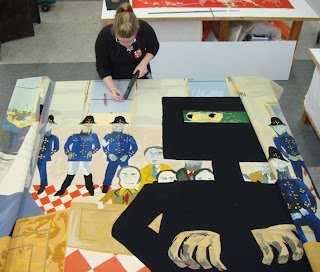
"The tiled floor in red and white was in a house I was in once. The courthouse was in South Melbourne and through the left-hand window you can see sailing ships of the time. The candelabra is true to life. The judge wears the black cloth of death and below is a sergeant with a rolled, sealed document that seals doom for Kelly. Of course, it could not have been ready. Kelly told Judge Barry that he would soon see him in the next world, which is not a very polite thing to say to a man who's just sentenced you to death. Strangely enough, Mr Justice Barry, a great man, who did many good deeds, went home to bed and died a fortnight later, from, it is said, a septic carbuncle."
Reproduced from Sidney Nolan's Ned Kelly Paintings in the National Gallery of Australia with essays by Murray Bail and Andrew Sayers

Over the past few weeks our Textiles Conservator has been carrying out conservation and maintenance work on a large tapestry from the Federal Law Courts in Sydney. The tapestry is a reproduction of Sidney Nolan's 1947 painting entitled "The Trial", which is held in the collection of the National Gallery of Australia.

The tapestry was produced under the supervision of Sidney Nolan in Portugal by Manufactura de Tapecarias de Portalegre, probably during the 1980s, and was in good condition when we received it from the Federal Law Courts. However, it had become quite soiled after hanging in the lobby outside Law Court 21A for many years.

Our challenge with cleaning large tapestries is to remove as much dirt as possible without damaging the tapestry - and when we're talking about something that measures more than 4m x 3m, and weighs 15-20kg dry (and three to four times that wet), this challenge can be substantial.
It is made even more difficult by the tendency of some dyes to run when exposed to water for a length of time. So the first challenge with any tapestry is to test the solubility and stability of every different colour of yarn used. In this case, we found that the red yarn began to run after 30 minutes of exposure to water ... and as you can see in the image of the original painting above, there is a lot of red, and it adjoins a lot of white or cream!

So in this case, we could not wash the tapestry with water, or use any stain removal reagents in aqueous solutions. Instead, our approach was to use a combination of brush vacuuming, tweezers (it's like picking needles from a haystack), and localised solvent cleaning. This approach is resulting in a substantial improvement in the condition of the tapestry.

Whilst not all of this improvement is visible to the naked eye, the removal of the particulate matter has a double benefit - not only does it slow down the deterioration of the tapestry by removing the generally acidic dust, it also reduces the rate of ongoing accumulation of dust (yes, dust begets dust - generally due to the static charges on the particulate matter).

24 April 2009

remembering the fallen

Tomorrow is the One Day of the Year. And in the run up to Anzac Day, it is interesting to reflect on the representation of war memorials and war memorabilia in our workload at International Conservation Services.

This week, our conservators have been carrying out conservation treatments on:


The Cenotaph in Martin Place, Sydney, in preparation for the Dawn Service to be held there from 4.30am on Anzac Day

A selection of war diaries kept by naval personnel

Several naval ensigns

But in the course of the past year, we have also treated such disparate items as:

Japanese military swords acquired by a private individual at the time of the Japanese surrender in WWII

WWII anti-aircraft Bofors gun currently located in Redfern Park

A German WWI Minenwerfer trench mortar owned by a Queensland local government authority

And we have undertaken other projects associated with war memorials or military sites including:

  • Design, documentation, fabrication and installation of interpretive devices at Fort Scratchley in Newcastle, NSW

  • Condition and significance assessment of the Mothers’ Memorial in Toowoomba, Queensland, and recommendations for maintenance
  • Dismantling and re-erection of the Shore School War Memorial during redevelopment of the grandstand at their Northbridge playing fields
  • Conservation and reconstruction of the War Memorial in Redfern Park, Sydney
  • Design, fabrication and installation of an interpretive display of war memorabilia at the Cabra Vale Diggers Ex-Active Servicemens Club
  • Fabrication and placement of a plaque to commemorate the distinguished military service (including award of the Victoria Cross) of a prominent individual in the church he attended for many years
The nature of all of these items is that they have enormous personal significance to many individuals, as well as to our community as a whole. We get insights into this in the course of our work, as our clients, or other people associated with the locations we are working at, tell us stories about the objects or places we are working on. These stories are often touching, frequently tragic, and serve to remind us of the sacrifices that have been made for our country. They remind us of our good fortune to live in Australia.

It is immensely satisfying to contribute to perpetuating the memory of those Australians who have served in the armed forces over the past 100 years or more.

David West
International Conservation Services

20 March 2009

removing graffiti

This week, three of our conservators have been working on a contemporary sculpture located on the idyllic shores of Sydney Harbour. A wonderful setting; but the work was rather less inspiring.

One of the major challenges we face in the conservation of public art is dealing with human impact on the artwork. And of course, graffiti epitomises the negative impact that comes from some members of our society.

Graffiti removal is almost always problematic. Often, the marker (paint or pen) penetrates the pores or surface roughness of the materials used for the sculpture, and cannot be easily removed. At other times, the process required to remove the graffiti causes damage to the substrate. And occasionally, on sculptures like Dual Nature by Nigel Helyer, the graffiti can actually alter the characteristics of the material itself.

Weathering steel (of which "Cor-Ten" is the most well-known type) is a particular type of steel that corrodes slowly on exposure, giving a uniform rusty brown finish. The most prominent use of this material in Sydney is the shaft of Sydney Tower.

The impact of graffiti on weathering steel is quite substantial.

Firstly, once the graffiti is applied, it slows the rate of corrosion in the areas beneath the graffiti. So that when the graffiti is eventually removed, even if it is completely removed, the surface will be visibly different because of the varying rates of corrosion.

Secondly, even with very careful solvent dissolution of the graffiti, some rubbing or abrasion of the surface of the weathering steel is inevitable, and hence the surface corrosion layer is lost, resulting in a visible difference.

At "Dual Nature", our team of conservators decided that given the age of some of the graffiti (several years) and the highly visible shadows from removal of graffiti in the past, we would scrub back the surface layer of corrosion across the entire face of the sculpture in order to minimise the visible difference between areas that had been attacked with graffiti, and those which had not.

This meant that after carefully removing the graffiti, our conservators spent many hours scrubbing the surface of these wonderful shell elements.

Given the highly exposed location, the salt-laden air will accelerate the process of corrosion, or weathering, of the Corten steel, so that the surface layer of corrosion will redevelop quite rapidly over the coming months.
David West