Showing posts with label conservation. Show all posts

23 September 2010

relaying a 19th Century tiled floor

We've just spent the past three months on our hands and knees in the Great Synagogue in Sydney.  And the result is that the tiled floor to the central portion of the Synagogue is now fully functional again. 

Laid with geometric and encaustic ceramic tiles on a cement mortar bed over a timber-framed floor in 1885, the floor had seen 125 years of services. 

Unsurprisingly, particularly given the structural alterations carried out beneath the Synagogue in the 1950s, some areas of the ceramic tiling were badly disrupted, with tiles cracked, loose and missing.

Over the past few years, we have been working with Peter Phillips of Orwell & Peter Phillips, Honorary Architect to the Great Synagogue, and Simon Wiltshier, structural engineer from Hughes Trueman, to investigate the problem and develop an appropriate conservation solution.

The recent works were undertaken in two phases.  First, structural interventions were undertaken to provide additional support to the timber floor structure.  This work was completed from beneath the floor without requiring any disruption within the Synagogue.  The second phase saw us progressively lifting and relaying the ceramic tiles.

We carried out the work so that each Friday afternoon we could vacate the Synagogue, leaving only a small area of the floor and a limited number of pews discreetly barricaded off.  Each Monday morning, we would open up new areas ready for the week's work.  We also stopped work several times each week during scheduled tours of the Great Synagogue.

We had previously procured replacement geometric and encaustic ceramic tiles for those missing or broken or excessively worn.  These replacement tiles came from Maw & Co, the English company which had manufactured the original tiles installed in 1885.  Needless to say, the limited number of replacements (5-10% of the total) and our work to lift and relay the floor cost rather more than the complete cost of the original tiles - the Great Synagogue's records show that the tiles originally cost £344/1/4 (three hundred and forty four pounds, one shilling and four pence), whilst the tiling cost £100.

We also worked with the specialist supplier of conservation materials, Westox, to develop a cementitious mortar that would be as close as possible to the original mix used to lay the tiles.  The composition of Portland cement has changed significantly since 1878, and it is now much stronger and chemically different to then.  The mix we developed used a combination of modern Portland cement and pozzolans to reduce the strength and shift the composition and characteristics of the mortar back closer to the 1870s Portland cement based mix in the original floor.

Other challenges included:
  • how to integrate the replacement tiles with the original tiles
  • resolving variations in the dimensional tolerances of the tiles and original joint widths
  • lifting and refixing the timber pews
We successfully relaid the floor in the time available to us, and based on our recent post-completion inspection, the floor stood up to all that the large wedding held a few days after we finished work could throw at it ... including breaking glass!

David West
International Conservation Services

24 March 2010

conserving heritage furniture

Conserving heritage furniture often challenges us to resolve conflicts between authenticity, minimal intervention and reversibility, and the need or desire for the furniture to continue to be used.

Recently we were presented with a set of such challenges as we embarked on a six-month long project to conserve the heritage Council Chamber furniture from the Sydney Town Hall.

This suite of Australian red cedar furniture was originally made by William Coleman for the Council Chamber of the Sydney Town Hall in 1883. The furniture was built to a design by one of the architects for the Town Hall, John Hennessey.

Photo: Historic image of the furniture in the Council Chamber of the Sydney Town Hall.

Comprising a long D-end table in two separate sections, the Lord Mayoral chair, 17 tub chairs, and 4 long benches (2 curved, 2 straight), all pieces of the suite were showing the signs of having been very well-used over a long period of continual service to the Council.

The tub chairs and benches had been re-upholstered numerous times, most recently in a manner quite different to the original. The legs of the chairs had been substantially modified, with repairs, replacements and extensions, none of which matched the original intent or appearance of the chairs. The tables had suffered mainly due to age and use, as well as through the cutting of holes and slots for telephone and computer cables.

The brief from our client, the City of Sydney, was to return the suite of furniture close to its intended original appearance whilst ensuring that it retained the patina of age and history. In addition, as the furniture was proposed to continue to be used for public events and functions, it was important that the conserved items be functional.

Photos: Tub chair prior to (L) and after (R) conservation

As a result of the original design and fabrication of the furniture, we needed to stabilise all of the joints in the tub chairs, and drew on a range of techniques to do this including:

  • Injection of animal hide glue
  • Dismantling of joints (by unscrewing, as the chairs had no traditional mortice and tenon joints), cleaning and re-gluing
  • Re-securing the screws
  • Installation of large curved blocks to the inside of the seat using adhesive
Previous unsympathetic (and weak) extensions to the legs of the tub chairs were removed. We designed and fabricated new extensions which were milled from old Australian cedar to match the original timber, and which followed the original form based on historic photographs.

We completed an assortment of other treatments in order to rectify damage caused by previous repairs or modifications to the tub chairs.

A decision was made at the beginning of the project to retain one of the seventeen tub chairs in the condition we received it in order to show the range of past repairs.

We decided to replace all of the leather during our conservation works, as none of the extant upholstery was original, nor did it look like the original. The tub chairs and benches were re-upholstered to match as closely as possible the original upholstery based on our interpretation of remnant physical evidence and the historic image above. Most notable is the recreation of the original buttoning.

Upon completion of the physical conservation works, the timber elements were refinished with shellac and waxed.

Photo: Council Chamber furniture after conservation works complete

Perhaps the greatest challenge with this project was resolving issues arising from the well-meaning repair and modification works carried out to the Council Chamber furniture in the course of its 125 year history.  It is likely that few of these repair and modification works would have been carried out with any anticipation that one day this suite of furniture would have such historic significance to the City of Sydney.  We are pleased that we have been able to unravel some of the changes that had occurred over time, to reveal the original form of this imposing furniture.

David West
International Conservation Services

16 March 2010

reversing the damage of a previous restoration

Photo: Overall shot before treatment

A beautifully painted portrait of a lady arrived at our door in a horrendous condition. The canvas had suffered severe shrinkage, the paint layer had been forced together, and having nowhere to go, had lifted away from the canvas forming tent-like shapes across the surface of the painting.

Photo: Close up of paint layer

As we investigated the cause of the canvas shrinkage, we found that a restorer had previously attempted to line the canvas using a water based adhesive. Lining is a procedure where a new canvas is adhered to the original canvas in order to add strength and support. However, we try to avoid lining paintings unless it is absolutely necessary because of the risks involved. Poorly executed lining can cause shrinkage of the canvas with associated damage to the paint layer, but can also change the texture and gloss of the paint layer. When carried out correctly, lining can result in a successful stabilisation of the painting without harm.

As conservators we think a lot about how we are going to treat an object. Often, it seems to us that conservation can be more about knowing what we cannot do rather than what we can. It is very easy to re-touch that missing section of paint, or glue a sculpture back together, but what are the consequences of our actions? In essence, this is what our training and code of ethics are all about – how do we treat the problems with an artwork or artefact whilst maintaining its significance and authenticity, and causing no harm to it now or in the future.

Our treatment of this painting was a lengthy and slow process. Over weeks the adhesive was slowly removed, first by softening it with solvents, and then by mechanically scraping away the adhesive. Simultaneously, we slowly stretched the canvas on an expandable stretcher, millimetre by millimetre. Once the canvas was its original size the tenting paint was then laid back into place.

The varnish layer on top of the paint was also badly damaged from the cracking and needed to be removed. Unfortunately, as the varnish was not a conservation grade varnish, it was not soluble in any solvents that did not also damage the paint layer. Consequently, the varnish had to be mechanically scraped away, which took one conservator three weeks to do.

Photo: After treatment

Finally, we lined the painting using the correct materials and processes, before varnishing, filling of losses and re-touching of damage. The overall results were very pleasing but some evidence of the damage still remains in the surface texture.

Photo: After treatment detail

Projects like this remind us of the challenges our clients face in finding a conservator. Conservators undergo extensive training, and generally specialise in just one field, e.g. paintings or paper or sculpture or metals or furniture / wood or textiles. Most conservators have tertiary qualifications – either an undergraduate or masters degree – and have several years experience on the job working with another experienced conservator in one area of conservation alone. When you find a conservator, it is always worth asking them about their qualifications, area of specialisation and experience, and if they have carried out this sort of treatment before.

Communication is also important so that both you and the conservator understand what you wish to achieve from the conservation treatment, and what the conservator expects the outcome from treatment is likely to be. Returning a painting or artefact to a “new” condition is rarely possible or appropriate, but treating it to bring it into a stable and presentable condition is almost always achievable. Prevention of damage is always far better than a cure, and once you have found a good conservator you can be confident that they have the best interests of your artwork, antique or artefact in mind.

Adam Godijn
International Conservation Services


07 March 2010

on display

As conservators, we are frequently involved in the preparation of objects for display in temporary or permanent exhibitions. This type of work is often challenging, for a variety of reasons, including:

  • Tight deadlines determined by a project manager or exhibition designer ... that don't take into account the practicalities of carrying out the conservation work itself.
  • A complex array of objects, in differing conditions, requiring a variety of conservation treatments.
  • Objects that tell fantastic stories, but that are in such a fragile state or deteriorated condition that it is extremely difficult to prepare them for display.
However, this type of work is also extremely fulfilling, because where the exhibitions are open to the public, we can see the outcome of our hard work, and take our families and friends along as well.

Many of the conservation treatments on objects intended for exhibitions relate to the removal of corrosion and staining as a result of ongoing deterioration so that the object can be more clearly understood when on display, as well as aiming to stabilise the condition of the object so as to halt or slow the rate of that ongoing deterioration.

As well as carrying out the actual conservation treatment, we also need to provide the curators of the exhibition with recommendations for the management of the items whilst on exhibition. These recommendations may include:

  • limits on light intensity to minimise deterioration
  • time limits for display of the object to minimise deterioration
  • need for regular cleaning or re-treatment to manage ongoing corrosion
  • methods of support or presentation that will not stress the object
Finally, we are often asked to fabricate mounts to support the objects whilst on display. This requires both an understanding of the condition of the object, and the exhibition designer's aim in displaying the object. Sometimes these requirements are in conflict, and we need to work with the exhibition designer and curator to find the optimum compromise.

Last year, International Conservation Services undertook conservation treatments on more than 150 objects destined for the new permanent exhibition at the Anzac Memorial in Hyde Park, Sydney, which was opened in November. We also prepared mounts for many of the objects.

These objects included a wide variety of wartime memorabilia and ephemera. We found this project particularly challenging because of the unexpected emotional impact of many of the objects.


In particular, working with documents such as the telegram above provided an immediate window into the emotional impact of the war on families.


The WWI miniature medal illustrated above before and after conservation had been adhered into a storage pocket. We removed it from the pocket, and carried out the following treatments:
  • cleaned with ethanol and degreased with white spirit
  • metal polished with silver cleaning cloth
  • tarnish removed with solution of thiourea in water
  • medal coated with clear lacquer to minimise tarnishing whilst on display
  • loose threads on ribbon cut, and ribbon stitched back into shape
One of the more intriguing objects we treated was this artificial leg.


A combination of rubber, wood, aluminium, copper alloy, iron alloy and canvas, it presented us with a range of challenges. Our treatments comprised:
  • brush vacuuming of the entire object
  • cleaning of iron alloy components (hinges) with white spirit, fine steel wool, and tannic acid removed with ethanol
  • cleaning of copper alloy components with a combination of dilute solutions of triammonium citrate and citric acid, and thiourea, along with mechanical methods (bamboo skewers and scalpel)
  • coating of metallic elements with microcrystalline wax to reduce the rate of ongoing corrosion whilst on display
  • reattachment of lace-up hooks

David West
International Conservation Services

18 January 2010

Christ Church in Bong Bong

One of the great things about working in conservation is that almost all of our work makes a difference, both to the objects that we conserve, and for the people to whom the objects are significant.

But from time to time, we get the opportunity to work on projects where the difference our work makes is highly visible, even transformative.

Such was the case late last year with our work on the decorated interiors of the Anglican Christ Church at Bong Bong in the Southern Highlands of NSW. Listed on the NSW State Heritage Register, it is the oldest church in the region, dating from 1845, and for some time, it was the only church between Sydney and Goulburn.

International Conservation Services was originally requested to conserve the interior paintings and decorative elements of the church. But after some discussions with the parish, we found that we could help the church with a broader project involving advice on the colour scheme, redesign of the internal church lighting, as well as work on the timber pews and running a training course for the parish members on how to care for them.

The large areas of flaking paint found in the artwork and decorative paintwork of the ceiling were of primary concern to our painting conservation team of Adam Godijn, Arek Werstak and Matteo Volonte, who spent a long fortnight working in demanding conditions of up to 40 deg C just below the ceiling of the church.

The flaking paint areas were consolidated as a priority before the extensive cleaning works required to the decorative ceiling were commenced. In order to avoid the heat, the team worked as early in the morning as possible.

After cleaning and consolidation of the paint layers, the losses were filled and inpainted before a final varnish layer was applied. This reversible varnish layer serves as a protective coating from the dust, dirt and debris that will collect in time, and also improves the appearance of the decoration by saturating the surface.

During planning for these works, we undertook a variety of paint investigations around the church to confirm the extent of original decorative finishes, and to attempt to identify the original colour scheme. These investigations uncovered many interesting things.

We discovered that the white gloss enamel painted window frames originally had a wood grained finish. A specialist decorator was brought in to re-create this original wood-grained effect. Apart from looking much more interesting the dark oak-like wood grain significantly enhances and highlights the beautiful stained glass windows.

Investigations around the gothic lettering at the front of the church found that the original lettering was much more ornate, and much more in keeping with the style of the surrounding decorations. The existing lettering was quite harsh in blue and red, whereas the original lettering had three colours - red, blue and gold leaf. After some discussions, the original lettering was replicated.


The plain sections of the church interior were repainted by a local tradesman using a colour scheme developed from original colours revealed by our paint scrapes, and in consultation with representatives of the churchwardens.

During the painting works, all of the plaques on the walls had to be removed, so the opportunity was taken to clean and polish them all before they were re-installed after the painting works were complete.

And finally a new lighting system was installed that provides both uplight onto the ceiling decoration and also spotlights the decorative verses on the two end walls.

You can read more about our work in this article in the Southern Highland News.

We are delighted to have been able to contribute to revealing this real gem of a church interior in a historic region of NSW. Services are held in the church each Sunday if you are interested in visiting.

David West and Adam Godijn

24 July 2009

dancing in the gardens

Yesterday we were pleased to be present in the Royal Botanic Gardens, Sydney, when the marble statue "La Ballarina" was unveiled after conservation works by us. Here is the transcript of Julian Bickersteth's speech about our work on the statue at the unveiling:

The role of statuary as an essential part of great gardens is a universal one. I was recently at Sissinghurst, the Kent Castle where Vita Sackville West and Harold Nicholson created one of the great gardens of England between the wars. Harold was the garden planner, and on purchasing the property with its derelict gardens he hot footed it to Italy to buy classical statuary to provide focus for his garden vistas and spaces.

Fifty years previously Charles Moore, the Director of these Royal Botanic Gardens had been driven by the same desire to see statuary as an integral part of the design of the Gardens. "La Ballarina" as she stands somewhat coyly before us, is a direct result of his vision. Moore was lucky in that he was living in a time when contemporary values supported this vision. Prince Albert, Queen Victoria’s consort, was keen on the so-called ‘uplifting of the lower orders’, and promoted the use of classical statuary in gardens to educate those who could not afford the ‘grand tour’. Much closer to home Sir Henry Parkes was an enthusiastic provider of public sculpture to beautify the colony, and was responsible for sourcing and importing various sculptures from Italy for the 1879 Garden Palace International Exhibition.

"La Ballarina" (please note the 'a' in the middle where we would expect an 'e') dates from 1883 when it was part of a group of eight marble statues imported from Italy. These include the four allegorical statues of the "Seasons", and the "Boy extracting a thorn", a still much loved statue on the hill behind us. As was reported at the time:

An additional attraction has been given to our Botanic Gardens, in the form of eight marble statues which now gleam white against masses of dark green foliage in various angles of the many walks which are so much appreciated by our citizens and visitors”.

So what do we know of "La Ballarina"? She is a copy of a famous statue by Antonio Canova, the Venetian sculptor who lived from 1757 to 1822, whose work included "The Three Graces" now in the Hermitage, and "Theseus and the Minotaur" in the Victoria & Albert Museum. The original of "La Ballarina" has since disappeared but it is listed in Canova’s work as "La Danzatrice con il dito al mento (the Dancer with the finger on chin)". Finished in 1814 she was sold to a Russian diplomat.

The copy you see before us was almost certainly (I shall come back to the almost later) sculpted by an Australian, Charles Summers, who although born in Melbourne in 1858, had moved to Rome with his parents aged 11. He ran a successful business reproducing famous sculptures including those of Canova, was said to be friendly with two popes and made regular trips to Australia to sell his wares.
Unfortunately, however, over the years these sculptures fell upon hard times. Physically they were damaged by anything from a falling branch to a reversing truck. And perhaps more disastrously they fell victim to changing attitudes, ranging from the ‘menace to public morals’ of the more flagrant nudes in the early twentieth century, to the mass replication of classical statuary in suburban gardens in the 1970s, making them appear somewhat naff. How "La Ballarina" came to be headless and footless we do not know but at some stage in the 1960s or '70s she was moved to what is known by the RBG staff as ‘the Graveyard’, behind the Succulent Garden.

We now live in more enlightened times and it is wonderful to see these vital elements of the Gardens being restored. So my company was delighted when we were approached to undertake the restoration of "La Ballarina" as part of the Royal Botanic Gardens' heritage statuary program. The process has been an interesting one, as it is not quite as simple as plonking a block of marble on La B's head and carving something appropriate.

First of all we needed to ensure we knew what we were carving, bearing in mind La B’s title ("the Dancer with the finger on chin") in that we had no chin nor a finger to touch it with, nor incidentally a right foot. So we went to the Canova Foundation in Canova’s home town of Passagno near Venice, where they hold a gypsum copy of the statue, to see if they could either organise the copy of a head for us to be carved, or provide good quality photos that we could copy here. Quick as a flash came back a letter from one Carlo Nicoli, declaring that he could see from our photos that the statue had been made in an ‘exceptional way’ by his great grandfather, another Carlo Nicoli, and that he would be happy to reproduce the head if we could ship the whole statue to him. Happily however we were able to source from the Canova Foundation high quality photos of the copy, and more happily source here in Lidcombe the carving skills of Polish-born master mason Jacek Luszcyk. So what you see before you is Jacek’s wonderful work, copying from photos the form and feel of the original.

But the story was not quite over yet, as finding a piece of pure white Carrara marble of suitable size and carving quality is not as easy as popping down to your local Bunnings. We could find nothing in Australia and so went back to the Carrara area eventually sourcing from the appropriately named Cave Michelangelo a block of stone of the right quality and size. I say appropriately named because it was from the Seravezza quarry in Carrara where Michelangelo sourced the blocks of marble of such astonishing size and purity from which David and the Pieta and indeed all his sculptures were carved. Of such value was this marble that Michelangelo laconically noted the deaths of two marble workers in the quarry during lowering down a piece of marble whilst bewailing the shattering of a piece of marble that represented months of labour and many thousands of dollars in its retrieval.

The process of replicating a carved work is a complicated one. Firstly the photographs were gridded up and divided into a series of points to allow for accurate measurement. Then clay mock ups of the missing head and limbs were crafted on the statue. These were extensively reviewed and altered until all parties were happy that they reflected the original. The clay forms were then removed and plaster casts made of them. The new marble was cut to size and the process of carving began, working from the plaster casts. Before these were finished they were doweled and glued to the original statue, and the finer details around the join completed. The result was once again reviewed and small alterations made, and now you see the result before you.

Thus has been the story of the restoration of "La Ballarina". Her vital missing elements have been restored, her original parts cleaned, and she has been returned to her proper form and place here in the Gardens. Her head, fingers and feet once again gleam white against the dark foliage, and though this currently appears somewhat as odds with her original elements, rest assured in no more than a few months she will have weathered to once again look her full harmonious and seductive self.

Thank you.

You can read more about the unveiling in the Sydney Morning Herald, watch the ABC News report, or look at more photos from the unveiling.

David West
International Conservation Services

18 July 2009

our lunar heritage

One of my earliest memories is being sat down in front of our black and white television set to watch the first moon landing. I couldn't have told you the date, but given that Monday 20 July will be the 40th anniversary, I know that I was 4 years old at the time. Of course, many of us have stories about this moment that changed our history.

Over the years, ICS has conserved some fascinating artefacts and industrial objects, but today I'm writing about a project that some of our fellow conservators at Conservation Solutions in the US worked on for several years.


At the Johnson Space Center in Houston, Texas, the only remaining space-ready Saturn V rocket has been on display for over thirty years. Designed as a single-use object, that merely had to survive the very high loads during the launch acceleration, and ravaged by the extremely harsh climate in Houston (high temperatures, high humidity, high ozone and high salinity, not to mention the occasional hurricane), this rocket was in a very poor state in 2002 when the conservation works commenced.

I was fortunate enough to visit the site in November 2004 when Conservation Solutions had completed much of their investigation, analysis, trials and planning works ... and were about to commence the task of conserving the 100m long rocket. You can read more about the project here and here.

For me, one of the most fascinating aspects of this conservation project was the research work that the Conservation Solutions team had to undertake in order to discover just what materials had been used. Despite the rocket having only been built during the 1960s, less than 40 years previously, and despite being part of the enormous space program run by the USA at the time, records of the construction of the Saturn V rocket were incredibly difficult to obtain. Indeed, I understand that much of the information about the construction was gleaned from amateur rocket enthusiasts who had collected memorabilia and magazine articles from the 1960s, and who could tell, admittedly anecdotal, stories about the challenges of building and launching the rockets.

Having identified the materials of construction, another enormously challenging task for Conservation Solutions was to develop appropriate conservation techniques for modern materials that were no longer made, yet for which little, if any, previous conservation work had ever been undertaken.

And of course, for conservators, the challenge of scale was almost overwhelming. Used to working with scalpels and dentist drills, the tools of choice for conserving the Saturn V rocket included ultra-high pressure water jets.


The challenges of conserving the artefacts of our industrial and technological heritage are enormous - not only are there questions of authenticity around materials and finishes, but there are also the challenges of function and operability ... and there are always conflicts between these that have to be resolved. Planning can take into consideration many eventualities, but inevitably we face surprises once the conservation works begin.

David West
International Conservation Services

07 July 2009

uncovering ned kelly

In our last post, we talked about Ned Kelly, and a depiction of his trial in a large tapestry. Today, we're still talking about Ned Kelly - but this time it is about a forthcoming television documentary on the archaeological excavation of the Ann Jones' Inn, site of the 1880 siege by the Ned Kelly gang in Glenrowan, Victoria.
In May 2008, ICS Senior Objects Conservator Karina Acton provided specialist conservation advice to the Dig International team during this excavation. This site is best known as the site of the Ned Kelly siege in 1880.
The excavation discovered a fascinating variety of artefacts and remains of the Ann Jones Inn, and you can find out more this Thursday 9 July at 8.30pm on ABC television when "Ned Kelly Uncovered", hosted by Tony Robinson of "Time Team" fame, goes to air.

19 May 2009

Nolan, Kelly and a tapestry

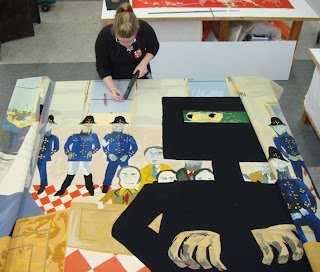
"The tiled floor in red and white was in a house I was in once. The courthouse was in South Melbourne and through the left-hand window you can see sailing ships of the time. The candelabra is true to life. The judge wears the black cloth of death and below is a sergeant with a rolled, sealed document that seals doom for Kelly. Of course, it could not have been ready. Kelly told Judge Barry that he would soon see him in the next world, which is not a very polite thing to say to a man who's just sentenced you to death. Strangely enough, Mr Justice Barry, a great man, who did many good deeds, went home to bed and died a fortnight later, from, it is said, a septic carbuncle."
Reproduced from Sidney Nolan's Ned Kelly Paintings in the National Gallery of Australia with essays by Murray Bail and Andrew Sayers

Over the past few weeks our Textiles Conservator has been carrying out conservation and maintenance work on a large tapestry from the Federal Law Courts in Sydney. The tapestry is a reproduction of Sidney Nolan's 1947 painting entitled "The Trial", which is held in the collection of the National Gallery of Australia.

The tapestry was produced under the supervision of Sidney Nolan in Portugal by Manufactura de Tapecarias de Portalegre, probably during the 1980s, and was in good condition when we received it from the Federal Law Courts. However, it had become quite soiled after hanging in the lobby outside Law Court 21A for many years.

Our challenge with cleaning large tapestries is to remove as much dirt as possible without damaging the tapestry - and when we're talking about something that measures more than 4m x 3m, and weighs 15-20kg dry (and three to four times that wet), this challenge can be substantial.
It is made even more difficult by the tendency of some dyes to run when exposed to water for a length of time. So the first challenge with any tapestry is to test the solubility and stability of every different colour of yarn used. In this case, we found that the red yarn began to run after 30 minutes of exposure to water ... and as you can see in the image of the original painting above, there is a lot of red, and it adjoins a lot of white or cream!

So in this case, we could not wash the tapestry with water, or use any stain removal reagents in aqueous solutions. Instead, our approach was to use a combination of brush vacuuming, tweezers (it's like picking needles from a haystack), and localised solvent cleaning. This approach is resulting in a substantial improvement in the condition of the tapestry.

Whilst not all of this improvement is visible to the naked eye, the removal of the particulate matter has a double benefit - not only does it slow down the deterioration of the tapestry by removing the generally acidic dust, it also reduces the rate of ongoing accumulation of dust (yes, dust begets dust - generally due to the static charges on the particulate matter).

24 April 2009

remembering the fallen

Tomorrow is the One Day of the Year. And in the run up to Anzac Day, it is interesting to reflect on the representation of war memorials and war memorabilia in our workload at International Conservation Services.

This week, our conservators have been carrying out conservation treatments on:


The Cenotaph in Martin Place, Sydney, in preparation for the Dawn Service to be held there from 4.30am on Anzac Day

A selection of war diaries kept by naval personnel

Several naval ensigns

But in the course of the past year, we have also treated such disparate items as:

Japanese military swords acquired by a private individual at the time of the Japanese surrender in WWII

WWII anti-aircraft Bofors gun currently located in Redfern Park

A German WWI Minenwerfer trench mortar owned by a Queensland local government authority

And we have undertaken other projects associated with war memorials or military sites including:

  • Design, documentation, fabrication and installation of interpretive devices at Fort Scratchley in Newcastle, NSW

  • Condition and significance assessment of the Mothers’ Memorial in Toowoomba, Queensland, and recommendations for maintenance
  • Dismantling and re-erection of the Shore School War Memorial during redevelopment of the grandstand at their Northbridge playing fields
  • Conservation and reconstruction of the War Memorial in Redfern Park, Sydney
  • Design, fabrication and installation of an interpretive display of war memorabilia at the Cabra Vale Diggers Ex-Active Servicemens Club
  • Fabrication and placement of a plaque to commemorate the distinguished military service (including award of the Victoria Cross) of a prominent individual in the church he attended for many years
The nature of all of these items is that they have enormous personal significance to many individuals, as well as to our community as a whole. We get insights into this in the course of our work, as our clients, or other people associated with the locations we are working at, tell us stories about the objects or places we are working on. These stories are often touching, frequently tragic, and serve to remind us of the sacrifices that have been made for our country. They remind us of our good fortune to live in Australia.

It is immensely satisfying to contribute to perpetuating the memory of those Australians who have served in the armed forces over the past 100 years or more.

David West
International Conservation Services

01 March 2009

repetition, concentration, commitment

Much of our conservation work is, by nature, very repetitive. Removal of grime from the surface of paintings with molecular sponges and cotton swabs. Cleaning of mould affected books. And so I admire the way our conservators are able to concentrate on this relentless repetition with their eye on the end-goal of conserving the object they are working on.

I've been thinking about this repetition as a result of several projects we're working on at present. We've got a team of six paintings conservators working on wall paintings in the Hellenic Community's Cathedral of Saint Constantine and Saint Helene in Northbridge, Perth. You can read more about their work in the project blog we set up to keep the Hellenic Community of WA up to date with the project.

We've also just completed a six week long project in a Sydney library cleaning mould from books in the special collection, where we had a team of up to six working under the supervision of our paper conservator. Brush vacuuming mould from every page of a rare book definitely qualifies as an endeavour requiring concentration and commitment.

The video below shows brush vacuuming of a mould affected ledger at our workshop.


David West
International Conservation Services

22 January 2009

a prefabricated industrial building

Last year we conserved an entire building. Every remaining piece of it, in fact. There were 27 cast iron columns, some of which were broken, and 9 trusses made from a combination of cast and wrought iron elements.
Currently known as the “Grissell Building”, in acknowledgement of the original manufacturers, Henry Grissell of London, this prefabricated industrial structure was discovered on the ACI site at Alexandria. Following documentation in 1997 by Godden Mackay Logan, the Grissell building was dismantled and stored on the site for ten years. In late 2007, we were awarded a contract by Meriton Apartments to conserve all of the elements so that the building could be re-erected in a park in the centre of the site.

We worked with heritage consultants Geoff Ashley and Rebecca Hawcroft of Godden Mackay Logan and structural engineers Simon Wiltshier and Alison Naimo of Hughes Trueman to develop an agreed approach to conservation of the Grissell building. In the end, we:
  • Blasted the cast-iron columns before painting with a zinc-rich epoxy primer and 2 pack polyurethane topcoat
  • Repaired the three broken columns by pinning the pieces to a new galvanised steel CHS installed inside the columns
  • Undertook various other repairs to the cast iron columns, including casting new capital plates
  • Deconstructed the trusses to straighten the wrought iron angle and flat bar tension members
  • Cast new compression strut members to replace broken or missing pieces of the struts
  • Installed new purlin angle supports to carry a new roof
  • Blasted and painted the trusses to match the columns
We were assisted with this work by Wrought Artworks (trusses), Traditional Stonemasonry (columns) and IMP Coating (blasting and painting).

The project had many challenging moments. The transport and hoisting of the nine roof trusses, which are quite lightweight, and therefore very flexible, caused us some of the most nerve-wracking moments.

The reconstruction of the Grissell building is now completed, with additional new roof truss components to help interpret the original configuration of the building. It is located in the public park between South Dowling Street and Broome Street, and serves as a shelter and seating area in the park for residents of the surrounding apartments.

Drop in and enjoy the delicate tracery of 19thC cast and wrought iron work sometime.

David West
International Conservation Services